Paracetamol (4-Acetamidophenol) ≥99% – Analytical Reference Standard, 1000 mg | CAS 103-90-2
- Home
- Paracetamol (4-Acetamidophenol) ≥99% – Analytical Reference Standard, 1000 mg | CAS 103-90-2
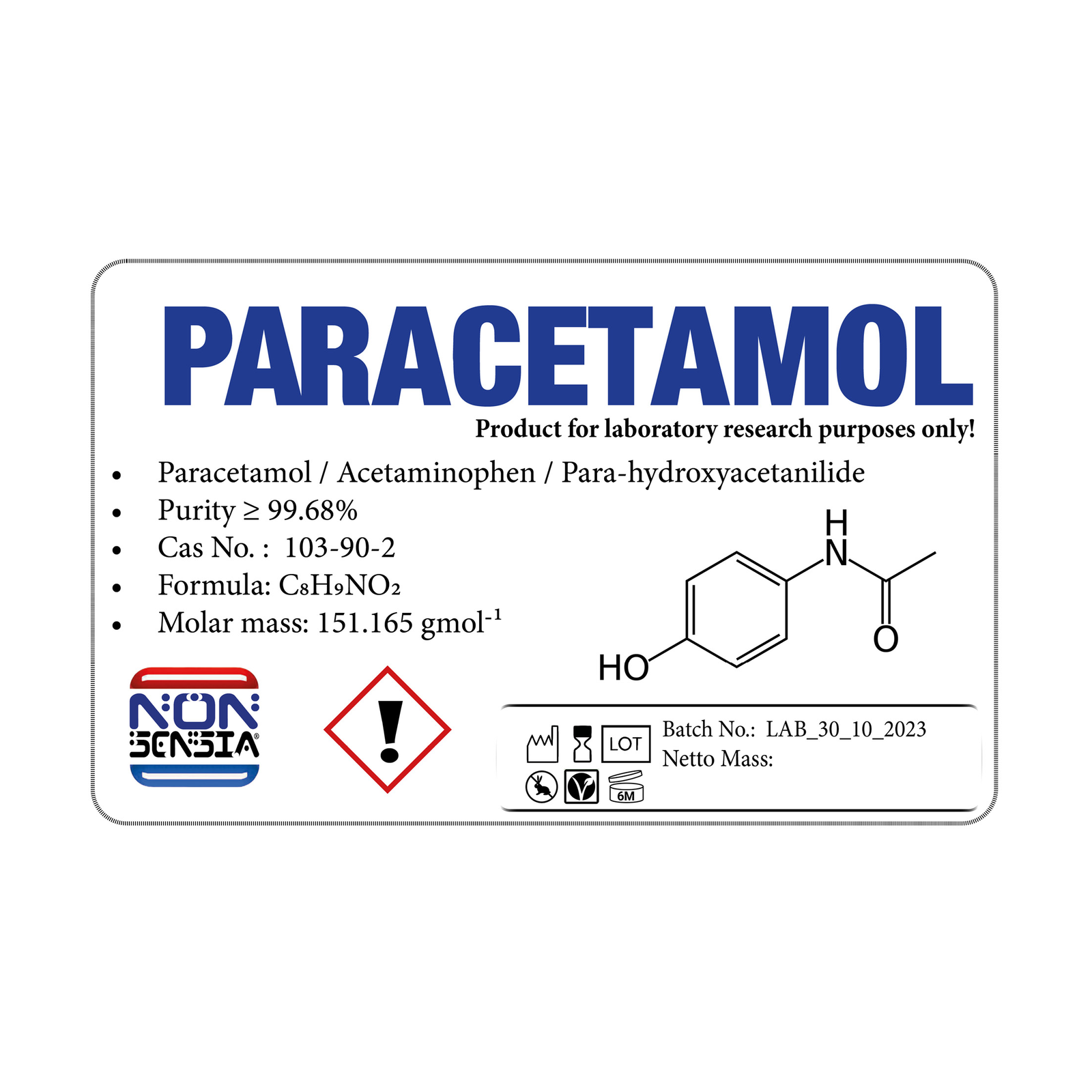
Paracetamol (4-Acetamidophenol) ≥99% – Analytical Reference Standard, 1000 mg | CAS 103-90-2
19,27 zł
Paracetamol Reference Standard — CAS 103-90-2, N-(4-hydroxyphenyl)acetamide, 1000 mg
Achiral 4-substituted acetanilide supplied for identity work, impurity control and method development. Laboratory reagent and analytical reference material only — not for human or animal consumption, and not a medicinal product. This is one of the most exhaustively characterised molecules in analytical chemistry, and the card below is about the one question all that characterisation does not answer.
- Read this first: the public record holds 149 deposited spectra, and 134 of them are mass spectra. The exact mass 151.063328530 Da is shared by 3,290 registry records with the same formula — including two positional isomers, one of which was itself marketed under four trade names. Ninety per cent of the spectroscopic evidence is the technique that discriminates least
- Net quantity: 1000 mg, single pack size
- CAS / EC / UNII / CID: 103-90-2 · 203-157-5 · 362O9ITL9D · PubChem 1983. Three further CAS numbers are recorded as deprecated for this same structure and still circulate in older paperwork: 8055-08-1, 719293-04-6, 1430221-00-3
- Formula / mass: C8H9NO2 · 151.16 g·mol−1 · monoisotopic 151.063328530 Da · InChIKey
RZVAJINKPMORJF-UHFFFAOYSA-N - Stereochemistry: four zeros in the registry record — no defined or undefined atom stereocentres, no bond stereocentres. Achiral. No chiral column, no enantiomeric excess, and any optical rotation quoted for this compound describes something that cannot exist
- The impurity that governs the specification: 4-aminophenol, formed by hydrolysis of the amide, limited to 50 ppm in the drug substance by the European Pharmacopoeia as reported in the validated-method literature. It is nephrotoxic in animal models in its own right and documented as hard to remove by ordinary recrystallisation. A stated purity of “99 per cent” leaves room for two hundred times that limit
- The decisive identity test: not mass. Reversed-phase retention against an authentic standard, or a proton NMR spectrum showing the symmetric AA′BB′ pattern of a para-disubstituted ring — which the 2- and 3-hydroxy isomers cannot produce
- Solid form matters and is not certified: monoclinic form I is the commercial solid; orthorhombic form II deforms plastically and is directly compressible where form I is not; form III went structurally unsolved until 2009. 31 CCDC deposits exist for this molecule, plus an oxalic acid cocrystal and a hydrochloride monohydrate
- Where the sources disagree: six melting points spanning 168–172 °C, water solubility values spanning roughly 600-fold, and fifteen Kovats retention indices from 1631 to 1694.6 — all in one record, each with its attribution shown below
- Hazards: Warning — H302 at 98.1 per cent of notifiers, H412 at 36.8, H315 at 17.4, H319 at 17.1, aggregated from 432 company reports across 47 notifications. Five of those 432 report no GHS hazard at all. No CLP Annex VI harmonised entry, measured against the ECHA harmonised list with working positive controls
- WADA 2026: not prohibited — four search terms returning zero against five positive controls that fire in the same document
Everything below is measured rather than asserted: 45 cited sources, every negative statement paired with a positive control on the same document, every physicochemical figure carrying the name of the source it came from, and an explicit list in section 14 of what this page does not certify — lot purity, 4-aminophenol content against the 50 ppm limit, solid form, water content and shelf life. Figures such as “≥99.0 per cent HPLC grade”, fixed shelf-life periods and claims of conformance “far below pharmacopoeial thresholds” circulate widely in commercial listings for this substance; they are supplier assertions about unspecified lots, not registry values, and none of them names an impurity, a threshold or a method.
Quick Payment
100% New
Fast Delivery
- Additional Information
Product classification — read before ordering. This item is a chemical reagent and analytical reference material. It is not a medicinal product, dietary supplement, food, feed, novel food or cosmetic, and it is not intended for human or animal consumption or for any in-vivo administration whatsoever. It is supplied exclusively to laboratories, research institutions and professional users for in-vitro analytical, chromatographic and method-development work. Scientific findings summarised on this page describe substances investigated in published laboratory and clinical research; they are reported here as bibliographic facts about that literature and are not product claims, dosage guidance, or a recommendation of any use of this reagent.
The strongest analytical fact about this compound is a ratio, and it runs the wrong way. The public spectroscopic record for paracetamol holds 149 deposited spectra. 135 of them — ninety per cent — are mass spectra [1]. Mass spectrometry is precisely the technique that cannot separate this substance from the 3,290 registry records that share its molecular formula and therefore its monoisotopic mass of 151.063328530 Da to the last decimal place, one of which is a marketed positional isomer with trade names of its own [1][3][4]. Against that, the record holds one deposited infrared spectrum, one attenuated-total-reflectance spectrum from a single supplier lot, and no ultraviolet curve at all — for a molecule whose most widely published assay is liquid chromatography with ultraviolet detection. Sections 4 and 9 set out what follows.
Key facts
- Substance
- Paracetamol (INN); acetaminophen (USAN); N-(4-hydroxyphenyl)acetamide
- CAS
- 103-90-2
- Deprecated CAS
- 8055-08-1 · 719293-04-6 · 1430221-00-3 — all three recorded as deprecated for this structure (section 2)
- EC number
- 203-157-5 [1]
- UNII (FDA)
- 362O9ITL9D [1]
- PubChem CID
- 1983 [1]
- Formula
- C8H9NO2
- Molecular mass
- 151.16 g·mol−1
- Monoisotopic mass
- 151.063328530 Da — shared with 3,289 further registry records of the same formula
- InChIKey
RZVAJINKPMORJF-UHFFFAOYSA-N- Stereocentres
- 0 defined, 0 undefined, 0 defined bond, 0 undefined bond — achiral, no chiral method applies
- Melting point
- Sources disagree across 168–172 °C; see section 8 for each value and its attribution
- Water solubility
- 14,000 mg·L−1 at 25 °C (compilation) against >22.7 µg·mL−1 at pH 7.4 — a spread of roughly 600-fold in one record
- pKa
- 9.38 (phenolic hydroxyl; the amide nitrogen is not basic in water)
- Principal impurity
- 4-aminophenol, the hydrolysis product, limited to 50 ppm in the drug substance by the European Pharmacopoeia as reported in the analytical literature [10]
- Solid forms
- Monoclinic form I, orthorhombic form II, form III; 31 CCDC deposits; 31 Crystallography Open Database deposition numbers plus 29 further COD records listing this compound as a component [1]
- GHS
- Warning — H302 (98.1%), H412 (36.8%), H315 (17.4%), H319 (17.1%), from 432 reports by companies across 47 notifications; no CLP Annex VI harmonised entry [1][6]
- ATC
- N02BE01 (human), QN02BE01 (veterinary) [1]
- WADA 2026
- Not prohibited — measured with positive controls [8]
- Net quantity
- 1000 mg, single pack size
On this page
- What this material is
- Identity and registry codes
- Structure: what there is not to worry about
- The central problem: an exact mass shared 3,290 ways
- Identity traps in the paperwork
- The impurity that defines the specification
- Solid form: three polymorphs and a tabletting problem
- Physicochemical data, and where the sources disagree
- Spectra: an abundance with a hole in it
- Methods that discriminate, and methods that only quantify
- Hazard classification
- Regulatory status
- Handling, storage and documentation
- What we certify and what we do not
- Terms of supply
- Questions and answers
1. What this material is
This page describes paracetamol supplied as an analytical reference material: a weighed quantity of a single identified substance, intended to serve as the point of comparison against which another sample is measured. A reference material has one job, and it is a narrow one. When a laboratory reports that a tablet assays at a given content, or that a degradation study has generated a particular impurity at a particular level, or that a chromatographic peak is or is not the analyte, everything in that report inherits the identity and the purity of one vial.
Most compounds in a reference-standard catalogue present the same shape of problem: too little public data. Somewhere on the shelf there is a substance with two published papers, no deposited spectrum of any kind, and no entry in any chemicals inventory — chlodantane is that case, and its card is mostly an inventory of absences. Paracetamol is the opposite case, and it is worth stating plainly because the opposite case has its own failure modes. This molecule has thirty-one deposited crystal structures, a hundred and forty-nine deposited spectra, two hundred and ninety-one records in one national medicines register alone, a pharmacopoeial monograph in every major compendium, and a methodological literature running to thousands of papers. Nothing about it is unknown for want of measurement.
What it does have is a discrimination problem, and abundance of data does not solve discrimination problems — it disguises them. Three specific facts drive everything that follows:
- The formula is small and therefore crowded. C8H9NO2 is shared by 3,290 records in the public compound registry [1]. Two of the closest of them, the 2- and 3-hydroxy positional isomers, are not laboratory curiosities: the 3-isomer, metacetamol, carries four historical trade names of its own [3][4].
- The substance hydrolyses into a named, limited impurity. 4-aminophenol is the primary degradation product, it is nephrotoxic in its own right in animal models [15][16], and the European Pharmacopoeia limit reported in the analytical literature is 50 parts per million in the drug substance [10]. A material that has taken up water on a bench generates the very thing the specification exists to control.
- The solid form is not a detail. The commercial solid is the monoclinic form I; a second, orthorhombic form II undergoes plastic deformation and is suitable for direct compression where form I is not [18][22][23]. Two vials of the same substance, identical by every mass measurement, can behave differently on a tablet press and in a dissolution vessel.
For the general terms on which this shop supplies reference materials, the surrounding reference standards category collects the rest of the catalogue on the same basis.
2. Identity and registry codes
Every identifier below is quoted from a public registry, with the registry named. Paracetamol accumulates identifiers the way long-marketed substances do, and the accumulation is itself a hazard: a search that assumes one convention will silently miss records written in another, and a certificate archive keyed on the wrong string will merge or split records that ought to be kept apart.
| Preferred name | Paracetamol (INN); acetaminophen (USAN, USP); Latin paracetamolum |
|---|---|
| Systematic name | N-(4-hydroxyphenyl)acetamide |
| CAS Registry Number | 103-90-2 |
| Deprecated CAS numbers | 8055-08-1 · 719293-04-6 · 1430221-00-3 — all three appear in the record as deprecated for this structure |
| EC number | 203-157-5 |
| UNII (FDA) | 362O9ITL9D |
| PubChem CID | 1983 |
| ChEBI | CHEBI:46195 |
| ChEMBL | CHEMBL112 |
| DrugBank | DB00316 |
| DrugCentral | 52 |
| DSSTox | DTXSID2020006 |
| HMDB | HMDB0001859 |
| KEGG | C06804 (compound) · D00217 (drug) |
| NCI Thesaurus | C198 · C29495 |
| Nikkaji | J4.025H |
| NSC numbers | NSC3991 · NSC109028 · NSC755853 |
| RXCUI | 161 |
| MetaboLights | MTBLC46195 |
| PharmGKB | PA448015 |
| ICSC (IPCS) | 1330 [9] |
| HTS tariff code | 2924.29.62.10 |
| Wikidata | Q57055 |
| ATC / ATCvet | N02BE01 — anilides · QN02BE01 for the veterinary classification |
Machine-readable descriptors
| SMILES | CC(=O)NC1=CC=C(C=C1)O |
|---|---|
| Connectivity SMILES | CC(=O)NC1=CC=C(C=C1)O — identical to the line above, because there is no stereochemistry to strip |
| InChI | InChI=1S/C8H9NO2/c1-6(10)9-7-2-4-8(11)5-3-7/h2-5,11H,1H3,(H,9,10) |
| InChIKey | RZVAJINKPMORJF-UHFFFAOYSA-N |
| XLogP3 | 0.5 (computed) |
| Topological polar surface area | 49.3 Å2 |
| Hydrogen-bond donors / acceptors | 2 / 2 |
| Rotatable bonds | 1 |
| Heavy atoms / complexity | 11 / 139 |
| Formal charge / covalent units | 0 / 1 — free base, no counter-ion, no hydrate in this record |
| Isotope atom count | 0 |
Note the first two rows. For most molecules the isomeric and the connectivity-only SMILES differ, and the difference is exactly the stereochemical information that a careless database import discards. Here the two strings are character-for-character identical, because the molecule has no stereochemistry to lose. Compare tadalafil, where six records share the InChIKey skeleton and only the second block separates the active substance from its own pharmacopoeial impurity. For paracetamol the entire InChIKey is diagnostic within its own connectivity class. That is a genuine advantage, and it is worth saying so before section 4 explains what the InChIKey does not protect you from.
The single rotatable bond, eleven heavy atoms and complexity score of 139 describe a very small, very rigid molecule. Small and rigid is why the crystallography is so extensive (section 7) and why the vibrational spectra are sharp; it is also why the formula space around it is so densely populated (section 4).
3. Structure: what there is not to worry about
Paracetamol is a 4-substituted acetanilide: a benzene ring carrying a phenolic hydroxyl at one position and an acetamido group at the position para to it. The registry record states its stereochemistry without ambiguity, and the four counters are worth quoting exactly as they stand [1]:
| Defined atom stereocentre count | 0 |
|---|---|
| Undefined atom stereocentre count | 0 |
| Defined bond stereocentre count | 0 |
| Undefined bond stereocentre count | 0 |
| InChI stereo layer | absent — the InChI string ends after the hydrogen layer |
| Isotope atom count | 0 |
| Formal charge | 0 |
| Covalently bonded units | 1 |
Four zeros. The molecule is achiral. There is no enantiomer, no diastereoisomer, no racemate, no enantiomeric excess to certify and no chiral column to buy. Any certificate, listing or specification quoting an optical rotation for paracetamol is describing something that cannot exist, in the same way that a rotation quoted for apigenin or bromantane would be. This is not a small saving: for a chiral active substance the stereochemical purity question typically requires a dedicated method, a dedicated standard and a dedicated argument on the certificate. Here it requires none of those, and the analytical effort that would have gone into it is better spent on section 6.
The functional group inventory is short and every entry matters analytically:
| Group | Consequence for the analyst |
|---|---|
| Phenolic hydroxyl | Weakly acidic, pKa 9.38 [1]. Ionised above roughly pH 10, which is why capillary electrophoresis methods for this compound run at high pH and why the substance is recorded as decomposed by strong alkalies [1]. It is also the site of the oxidative chemistry that turns a white powder pink. |
| Secondary amide (anilide) | Not basic in water. Hydrolysable to 4-aminophenol and acetic acid — the reaction that section 6 is about. The amide is the reason the ATC class is literally named anilides. |
| Para-disubstituted benzene | A strong ultraviolet chromophore, absorption maximum reported at 250 nm with molar absorptivity 13,800 in ethanol [1]. This is the basis of nearly every published assay, and section 9 explains why the record nonetheless holds no ultraviolet curve. |
| One rotatable bond | Essentially a planar, conformationally locked molecule. Rigidity plus two hydrogen-bond donors and two acceptors is the recipe for rich polymorphism, and section 7 is the result. |
Two further descriptors are worth reading together. The computed XLogP3 is 0.5 and the topological polar surface area is 49.3 Å2. A logP near zero on a molecule of 151 Da means a compound that is neither confidently aqueous nor confidently organic; in reversed-phase chromatography it elutes early, close to the void, which is exactly where the polar degradation products also elute. That single number explains a surprising amount of the method-development literature in section 10.
4. The central problem: an exact mass shared 3,290 ways
Section 3 disposed of stereochemistry. What remains is constitutional isomerism, and for a molecule this small it is a far larger problem than stereochemistry ever is.
A formula search of the public compound registry for C8H9NO2 returns 3,290 records [1]. Every one of them has the molecular mass 151.16 g·mol−1 and the monoisotopic mass 151.063328530 Da — not approximately, but identically, because it is the same arithmetic performed on the same atoms. No mass measurement at any resolution separates them. An instrument that could resolve 151.063328530 from 151.063328531 would still return the same number for all 3,290, because it is the same number.
Most of those 3,290 are obscure. Four are not, and one of the four has been sold as a medicine:
| Compound | CID / CAS | InChIKey | Why it matters |
|---|---|---|---|
| Paracetamol — this product 4-hydroxyacetanilide | 1983 / 103-90-2 | RZVAJINKPMORJF-UHFFFAOYSA-N | The reference substance |
| Metacetamol 3-acetamidophenol | 12124 / 621-42-1 | QLNWXBAGRTUKKI-UHFFFAOYSA-N | A marketed medicine in its own right, recorded under the trade names Pedituss, Metalid, Pyrapap and Rystal [3]. Same formula, same mass, one substituent moved by one ring position |
| 2-acetamidophenol ortho-hydroxyacetanilide | 11972 / 614-80-2 | ADVGKWPZRIDURE-UHFFFAOYSA-N | The remaining positional isomer; also encountered as a synthetic by-product [4] |
| Methyl anthranilate | 8635 | VAMXMNNIEUEQDV-UHFFFAOYSA-N | A wholly different substance class — an ester, not an amide — and indistinguishable by exact mass alone [1] |
| 4-methoxybenzamide | 76959 | GUCPYIYFQVTFSI-UHFFFAOYSA-N | Primary amide plus methyl ether; again, same mass to the last digit [1] |
Read the third column and then read it again against the equivalent table on the tadalafil card. There, six substances shared the same InChIKey skeleton and were separable only by the second block. Here, the InChIKeys are entirely different from the first character — and that is precisely the point. The InChIKey discriminates perfectly and the mass spectrometer discriminates not at all, and the second of those two is the instrument that most laboratories actually own. A key is a bookkeeping device; it tells you nothing about a powder in a vial until something physical has measured that powder.
Fragmentation does not rescue the identification either
The obvious answer is tandem mass spectrometry, and for the positional isomers it is a weak answer. The deposited peak lists are consistent across instruments [1]: protonated paracetamol at m/z 152.07 fragments principally by loss of ketene from the acetamido group to give the aminophenol cation at m/z 110.060, and thence to 93.034, 92.049 and 65.039, with a minor water loss at 134.060. In negative mode the deprotonated molecule at 150.056 gives 107.038 by the same logic, and under electron ionisation the molecular ion at nominal 151 is dominated by the fragment at 109. Every one of those transitions is driven by the acetanilide connectivity, which the 2- and 3-hydroxy isomers share atom for atom. The registry holds 104 deposited liquid-chromatography mass spectra for this compound, 103 of them carrying a hashed spectral identifier, across six instrument types and both ionisation polarities [1]. That is an unusually deep spectral library. It is also a library of the same information repeated, because every one of those spectra reports on connectivity, and connectivity is what the positional isomers have in common.
What actually separates them: retention, not mass. The three hydroxyacetanilide isomers differ in polarity, hydrogen-bonding geometry and dipole, and therefore in reversed-phase retention. They are routinely resolved on an ordinary C18 column. The discrimination lives entirely in the x axis of the chromatogram, and the x axis is only as trustworthy as the standard used to fix it. This is the concrete reason a reference material exists for a compound nobody has trouble detecting: detection was never the difficulty. Assignment was.
The deuterated analogue, and the one thing it proves
There is a labelled version of this molecule in the registry, and it is instructive for the same reason the labelled version of every difficult analyte is. Acetaminophen-d4, CID 12205925, carries four deuterium atoms on the ring [5]. Its monoisotopic mass is 155.088435514 Da, greater by 4.02510698 Da, and its InChIKey is RZVAJINKPMORJF-QFFDRWTDSA-N — same skeleton, different second block, isotope atom count 4 rather than 0.
That four-dalton offset is the entire reason the compound exists. A deuterated analogue co-elutes with the analyte, ionises and fragments the same way, suffers the same matrix suppression, and is nonetheless separately countable because the instrument can see the gap. The only member of this family that mass spectrometry reliably distinguishes is the one deliberately built to be distinguishable — and it was built that way by moving mass, because moving atoms around the ring would not have worked.
There is a sting in this particular case, and it belongs in section 5 as much as here: the registry's removed synonyms list for unlabelled paracetamol contains the strings Paracetamol-d4, Acetaminophen-d3 and Acetaminophen-d4 [1]. Those are names of different substances that were at some point attached to this record. Any workflow that resolves an internal standard by name against a synonym list has a documented route to ordering the wrong material.
5. Identity traps in the paperwork
For a compound this well characterised, the residual risk is almost entirely documentary. Five traps recur, and all five are visible in the public record rather than hypothesised.
Trap 1: three deprecated CAS numbers still in circulation
The record carries CAS 103-90-2 as current and three further numbers marked deprecated for the same structure: 8055-08-1, 719293-04-6 and 1430221-00-3 [1]. Deprecated does not mean deleted — it means retired from the authoritative registry while remaining in every document that was written before the retirement, and in every database that imported such a document. A purchasing system matching on CAS will treat a certificate quoting 8055-08-1 as referring to an unknown substance, and a reconciliation performed by hand will treat it as a typographical error. It is neither. The same shape of problem appears with retired identifiers on the sildenafil card, and it is systematically underestimated because the failure is silent in both directions.
Trap 2: the synonym list has been contaminated, and the registry says so
The removed synonyms field of the record is a long list of strings that were once attached to this compound and have since been withdrawn [1]. Read as an audit trail rather than as a name list, it is remarkable. It contains, among several hundred entries:
- Names of entirely unrelated chemicals — di-tert-butyl dicarbonate and 3-(iodomethyl)-1,1-dimethoxycyclobutane both appear.
- Names of deuterated analogues: Paracetamol-d4, Acetaminophen-d3, Acetaminophen-d4 [5].
- Impurity designations belonging to other substances: Amodiaquine Impurity B, Paracetamol EP Impurity N, Acetaminophen impurity B. Paracetamol is a designated impurity of other active substances as well as a substance in its own right.
- A controlled-substance code, DEA No. 9804, on a substance that is not scheduled anywhere in the material examined for section 12.
- The strings C8H9NO2, CID1983 and RZVAJINKPMORJF-UHFFFAOYSA-N treated as though they were names.
- Vendor catalogue text carrying a pharmacological mischaracterisation: “4-Acetamidophenol, 98.5%, a selective cyclooxygenase-2 inhibitor - 250G 250g”. That description does not match the pharmacological classification the same record carries elsewhere, and it entered the identity layer of a chemical database as a name.
- An occupational-hygiene entity, Paracetamol, inhalable dust, which is an exposure form rather than a substance.
None of this is a criticism of the registry, which is doing the right thing by publishing what it withdrew. It is a warning about any pipeline that resolves substances by name. Name matching on this compound has demonstrably matched the wrong molecule, the wrong isotopologue, the wrong impurity designation and a fragment of a sales listing.
Trap 3: two names, two continents, one documented clinical consequence
Paracetamol and acetaminophen are the same substance under two international naming conventions, and the coexistence is not merely untidy. A case report in Current Drug Safety describes an overdose episode missed because of confusion over the drug name: material purchased online was described by the patient under an unfamiliar name and was initially attributed to a different, unrelated analgesic [45]. The authors frame the problem as a direct consequence of consumers having access to medicines named differently from the local convention.
For a reference-material buyer the analogous risk is duller but real: a laboratory information system holding acetaminophen and a certificate reading paracetamol will not reconcile automatically, and an analyst reconciling them by hand has to know that they should. Add APAP, 4-acetamidophenol, 4-hydroxyacetanilide and N-acetyl-p-aminophenol — all in current use — and a single substance occupies six shelves in a poorly keyed inventory.
Trap 4: the register itself is not internally consistent about strength
This one is measurable rather than anecdotal. Of the 107 single-substance paracetamol records in the Polish Register of Medicinal Products, six state their strength as “1000 mg” and six state it as “1 g” [7]. Those are the same quantity written two ways, in the same field, in the same register, and any script that groups by the strength string will report twelve products as two populations of six. This is exactly the class of defect that a text-matching detector produces and that a unit-aware one does not, and it is worth knowing about before quoting counts from any register.
Trap 5: salt, hydrate and cocrystal forms exist in the literature
The material on this page is the neutral, anhydrous free base: formal charge zero, one covalently bonded unit, isotope count zero [1]. Other solid forms of the same molecule are documented and are not this article. A 2026 solid-state nuclear magnetic resonance study refined the structures of monoclinic paracetamol, its cocrystal with oxalic acid and its hydrochloride monohydrate salt side by side [33]; a mechanochemical route to the oxalic acid cocrystal has since been scaled across several milling technologies [32]. These are separate materials with separate stoichiometries and separate masses on the balance. A certificate that says only paracetamol has not told you which of them is in the bottle.
6. The impurity that defines the specification
If one fact about this compound deserves to be on the first page of any specification, it is this one.
Paracetamol hydrolyses to 4-aminophenol, and 4-aminophenol is limited to 50 parts per million in the drug substance. The limit is stated as a European Pharmacopoeia specification in the validated-method literature: “According to the European Pharmacopoeia, 50 ppm 4-AP/PARA is the specification limit of 4-aminophenol in paracetamol drug substance”, with substantially higher limits customary for finished products [10]. Fifty parts per million is 0.005 per cent. A purity figure of “99.0 per cent” leaves room for two hundred times that amount of a single impurity and says nothing whatever about whether the limit is met.
Three things make this the governing analytical problem for the material rather than a footnote.
First, the degradant is generated by the substance itself. 4-aminophenol is described in the electrophoresis literature as the main hydrolytic degradation product of paracetamol, and it is found in environmental waters for the same reason [12]. Amide hydrolysis needs water, and a hygroscopically indifferent crystalline solid stored in a humid room has water. The mechanism does not require heat, light or catalysis, only time and moisture.
Second, the degradant is toxicologically distinct from the parent. 4-aminophenol is a recognised nephrotoxicant in animal models, and its role has been studied specifically as a deacetylation product of paracetamol: inhibiting the acylamidase that performs the deacetylation reduced the parent compound's renal toxicity but not that of 4-aminophenol given directly [15], and the biosynthesis of toxic glutathione conjugates from 4-aminophenol has been characterised separately [16]. The limit is not arbitrary tidiness; it is the reason there is a limit at all.
Third, the degradant is genuinely hard to remove. A 2020 study on organic salts of 4-aminophenol opens with the observation that removal of 4-aminophenol from paracetamol is challenging and difficult to achieve through regular crystallization approaches, and reports four new salts with salicylic, oxalic, L-tartaric and camphorsulfonic acids as a route to separating it [13]. A structurally similar, similarly polar impurity that co-crystallises with its parent is the worst case for purification, and it explains why the pharmacopoeial approach is a tight numerical limit backed by a sensitive method rather than a claim of absence.
Methods that reach 50 ppm, and what each costs
| Approach | What it achieves | Source |
|---|---|---|
| Fluorimetry after derivatisation | Developed and validated explicitly to quantify the 50 ppm level in tablets; linearity, precision, trueness, range and detection and quantification limits all reported | [10] |
| Micellar electrokinetic chromatography | Ten-minute separation in phosphate buffer at pH 9.0 with sodium dodecyl sulphate at 75 mM, 25 kV; quantification limit for 4-aminophenol reported as 6 µg·mL−1 | [11] |
| Capillary and microchip electrophoresis with contactless conductivity detection | Separation of parent and hydrolysis product in a β-alanine background electrolyte at pH 11 with 14 per cent methanol; migration-time relative standard deviations below 4 per cent | [12] |
| Chemometric spectrophotometry | Simultaneous quantitation of 4-aminophenol alongside caffeine, codeine and paracetamol without physical separation | [14] |
Note what the pH values in that table are doing. Both electrophoretic methods run at pH 9 or above, which is at or past the phenolic pKa of 9.38 [1]. The separation depends on the parent being at least partly ionised while the aminophenol, with both an amine and a phenol, sits differently on the same pH axis. This is a good illustration of a general point: for this compound the discriminating variable is almost never mass and almost always a solution-phase property — charge, polarity, retention.
A practical consequence for storage. The hydrolysis pathway is why the storage advice in section 13 emphasises dryness over temperature. It is also why the date a container was first opened is more informative for this substance than for most: a certificate of analysis describes the material at the moment of testing and cannot describe it after eighteen months in a room that runs humid. The degradant that grows is limited at 0.005 per cent, and a routine identity test by mass spectrometry will continue to return a perfectly correct answer throughout.
7. Solid form: three polymorphs and a tabletting problem
The solid-state literature on paracetamol is one of the deepest for any single organic molecule, and it exists for an entirely practical reason: the commercial form is bad at being pressed into tablets, a better form exists, and the better form is metastable.
| Form | What is established | Source |
|---|---|---|
| Form I, monoclinic | The thermodynamically stable form and the commercial solid. Structure determined in 1976; the Merck Index describes the material as large monoclinic prisms from water | [17][1] |
| Form II, orthorhombic | Structure redetermined at 298 K and 123 K, with a laboratory-scale solution crystallisation route. Unlike form I it undergoes plastic deformation and is suitable for direct compression | [18] |
| Form III | Long known but structurally unsolved until 2009, when the structure was determined from laboratory powder diffraction data combined with crystal structure prediction | [20] |
| Form III, stabilised | First air-stable formulation, obtained by melt crystallisation in the presence of β-1,4-saccharides acting as templating excipients | [21] |
| Forms II and III, prepared and characterised together | Preparation and physical characterisation of both metastable forms in one study | [19] |
| Crystal habits of form I | Habit modification by solvent polarity, rationalised in terms of molecular recognition at the solvent–crystal interface | [31] |
| Cocrystal with oxalic acid | Structure refined by solid-state nuclear magnetic resonance and density functional theory; mechanochemical synthesis scaled across multiple milling technologies | [33][32] |
| Hydrochloride monohydrate | Structure refined alongside the neutral form and the cocrystal | [33] |
| Deposited crystallographic data | 31 CCDC deposition numbers and 31 Crystallography Open Database deposition numbers, plus 29 further COD records that list this compound as a component of a multi-component crystal | [1] |
Why form II is chased and why it keeps escaping
Form I is brittle. It fractures rather than deforms under compression, which means a formulator cannot press it directly into a tablet without binders. Form II deforms plastically, and the commercial incentive that follows — tablets without binders — is stated explicitly in the 1998 characterisation paper as the reason so much effort has gone into producing it [18]. The compression behaviour of the orthorhombic form was then measured in its own right [23], a direct-compression grade was described [22], and the mechanical energies of compaction were compared between the two forms [24].
The obstacle is that form II is metastable and reverts. The literature reads as a twenty-year sequence of attempts to hold it still:
- The transformation of form II back to form I was tracked in real time by focused-beam reflectance measurement, turning the reversion into something observable rather than merely inferred [26].
- Multicomponent crystallisation routes made the “elusive polymorph” reproducibly accessible on a laboratory scale [29].
- A templating approach in a cooling environment delivered 100 per cent polymorphic phase-pure form II at scales up to 120 g [27].
- The same group moved the approach to continuous crystallisation, describing selective access to the metastable form as a process rather than a preparation [28].
- Paracetamol cocrystals were then used as templates in solution to direct form II selectively [30].
Alongside the crystallisation work, the two forms were shown to differ in surface energetics: advancing contact angles measured facet by facet on macroscopic single crystals established that the wetting behaviour is both anisotropic and polymorph-dependent [25]. Wetting drives dissolution, and dissolution is what a formulator is finally measuring.
What this means for a vial on a shelf. Three solid forms, at least one cocrystal, one salt hydrate, solvent-dependent habits and thirty-one deposited structures. Every one of them gives the same molecular formula, the same exact mass, the same fragment ions and the same solution-state nuclear magnetic resonance spectrum. The techniques that distinguish them — powder diffraction, thermal analysis, vibrational spectroscopy, solid-state nuclear magnetic resonance — are precisely the ones a routine identity check omits. If your work depends on solid form, it has to be measured on the material in front of you; section 14 states plainly that we do not certify it.
8. Physicochemical data, and where the sources disagree
The registry record for paracetamol carries an unusually full experimental-properties section, and it also carries contradictions that a careful reader should see rather than have resolved for them. Values below carry their attribution; where sources conflict, the conflict is reported rather than averaged.
| Property | Value | Attribution as given in the record |
|---|---|---|
| Physical description | Odourless white crystalline solid; bitter taste; pH of saturated aqueous solution about 6 | National Toxicology Program, 1992 |
| Physical description | Colourless crystals or crystalline powder | IPCS International Chemical Safety Card [9] |
| Colour and form | Large monoclinic prisms from water | Merck Index, 2013 |
| Melting point | 336 to 342 °F (equivalent to 168.9–172.2 °C) | National Toxicology Program, 1992 |
| Melting point | 168–172 °C | Supplier safety data sheet |
| Melting point | 168 °C | CRC Handbook, 94th edition |
| Melting point | 169–170.5 °C | Merck Index, 2013 |
| Melting point | 169–170 °C | IPCS ICSC 1330 [9] |
| Melting point | 170 °C | Human Metabolome Database |
| Boiling point | >500 °C | IPCS ICSC 1330 [9] |
| Water solubility | 14,000 mg·L−1 at 25 °C | Yalkowsky, Handbook of Aqueous Solubility Data, 2nd edition |
| Water solubility | 14 mg·mL−1 at 25 °C | Human Metabolome Database — numerically identical to the row above |
| Water solubility | 1.4 g per 100 mL at 20 °C, described as moderate | IPCS ICSC 1330 [9] |
| Water solubility | 1 to 5 mg·mL−1 at 72 °F | National Toxicology Program, 1992 |
| Water solubility | >22.7 µg·mL−1, mean of results at pH 7.4 | Sanford-Burnham Center for Chemical Genomics, PubChem BioAssay AID 1996, annotated as aqueous solubility in buffer at pH 7.4 |
| Water solubility, qualitative | Very slightly soluble in cold water, soluble in boiling water | Merck Index, 2013 |
| Organic solubility | Freely soluble in alcohol; soluble in methanol, ethanol, dimethylformamide, ethylene dichloride, acetone, ethyl acetate; slightly soluble in ether; practically insoluble in petroleum ether, pentane, benzene | Merck Index, 2013 |
| Density | 1.293 g·cm−3 at 21 °C | CRC Handbook, 94th edition |
| logP | 0.46 | Sangster LOGKOW database, evaluated experimental value |
| logP | 0.49 | IPCS ICSC 1330 [9] |
| XLogP3 | 0.5 | computed |
| pKa | 9.38 | Dastmalchi et al., 1995 |
| pH, saturated solution | 5.5–6.5 | Hawley's Condensed Chemical Dictionary, 15th edition |
| Vapour pressure | 6.29 × 10⁻⁵ mm Hg at 25 °C | Daubert and Danner, 1989 |
| Relative vapour density (air = 1) | 5.2 | IPCS ICSC 1330 [9] |
| Autoignition temperature | 540 °C | IPCS ICSC 1330 [9] |
| Collision cross-section | 129.7 / 130.56 / 132.2 / 139.3 Å2 for [M+H]+; 131.43 / 132.5 / 132.7 Å2 for [M−H]− | five independent published datasets, listed individually |
| Kovats retention index, non-polar | Fifteen values spanning 1631 to 1694.6 | fifteen separate depositions |
| Other | Decomposed by strong alkalies | Hawley's Condensed Chemical Dictionary, 15th edition |
The solubility spread is roughly six-hundred-fold
Read the solubility rows together. Three of them agree closely: 14,000 mg·L−1, 14 mg·mL−1 and 1.4 g per 100 mL are the same number written three ways, and they are consistent with the Merck Index description and with the compound being freely soluble in hot water. One row is not: >22.7 µg·mL−1 at pH 7.4 is 22.7 mg·L−1, roughly six hundred times lower.
The discrepancy is explicable rather than mysterious, and the explanation is worth stating because it recurs across this catalogue. A value carrying the qualifier greater than and a stated buffer pH is a kinetic solubility screen: material is precipitated from an organic stock into buffer and the concentration at which it stays in solution over a fixed short interval is recorded. Such a screen has an assay ceiling, and a compound that exceeds the ceiling is reported at the ceiling with a greater than sign. The National Toxicology Program entry of 1 to 5 mg·mL−1 is a third kind of number again — a coarse bracket. Three measurement designs, three answers, one column in one database.
The number to work from for stock preparation is the thermodynamic one, roughly 14 g·L−1 at room temperature, and it should be treated as strongly temperature-dependent: a dedicated two-part study measured and then modelled paracetamol solubility in water–isopropanol mixtures precisely because the temperature and cosolvent dependence governs crystallisation behaviour [34].
The melting point is not a sharp number, and quoting it as one is a small dishonesty
Six melting-point entries appear in one record, spanning 168 °C to 172 °C depending on source. Melting ranges quoted as narrow and sharp circulate widely in commercial listings for this substance and are presented there as evidence of purity; they are not registry values, and the registry itself does not agree with them to better than about four degrees. A melting point is also, for this molecule specifically, a solid-form measurement as much as a purity measurement: forms I, II and III of paracetamol have distinct thermal behaviour, and thermal analysis is one of the principal techniques used to tell them apart [19]. A single number on a certificate has therefore compressed two independent variables into one.
The retention indices disagree by sixty-four units
The record holds fifteen standard non-polar Kovats retention indices ranging from 1631 to 1694.6, plus four semi-standard non-polar values from 1693.1 to 1703 [1]. Sixty-four index units is a wide spread for a compound this well studied. It reflects genuine differences in column chemistry, temperature programme and derivatisation practice between laboratories, and it is a useful corrective to the idea that a library retention index is a physical constant. Anyone matching a gas-chromatographic peak against a library value for this compound should know which of the fifteen they are matching against.
Two absences worth naming
The record carries no refractive index and no flash point. Neither is surprising for a high-melting crystalline solid, and neither is a gap in the sense that section 9 means. They are noted here so that a reader looking for them knows they were looked for and were not found, rather than assuming they were omitted for space.
9. Spectra: an abundance with a hole in it
This is where the record for paracetamol is most impressive and most lopsided at the same time, and reading it correctly requires one methodological warning first.
A counting trap, stated before the numbers. The spectroscopic sections of the public record are stored as lists of fields, not of spectra: instrument type, solvent, ionisation mode, peak list and thumbnail are separate entries belonging to one measurement. Counting fields for this compound gives roughly 2,050 and is meaningless. Counting rendered spectra — one thumbnail per measurement — gives 149. Every number in this section is the second kind. We mention the first because an inflated count is the easiest possible way to make a thin spectral record look deep, and because the same trap is available in every database of this shape.
| Technique | Spectra | Notes on provenance |
|---|---|---|
| LC-MS | 104 | Six instrument types — ion-trap Fourier transform (31), quadrupole time-of-flight (24), quadrupole Fourier transform (23), triple quadrupole (15), single quadrupole (9), ion trap (1). 77 positive-mode, 26 negative-mode. Each carries a hashed spectral identifier permitting exact rather than visual matching |
| GC-MS | 15 | Eight carry hashed identifiers; six carry library reference numbers |
| MS-MS | 9 | Mixed provenance |
| Other mass spectrometry | 7 | — |
| 1H NMR | 3 | 500 MHz in 5 per cent DMSO at pH 7.00; 400 MHz in DMSO-d6; one historical Varian A-60 spectrum |
| 13C NMR | 2 | — |
| 15N NMR | 1 | Unusual to have one at all |
| 17O NMR | 1 | Rarer still |
| 2D 1H–13C NMR | 1 | A single heteronuclear correlation experiment |
| FTIR | 1 | Bruker IFS 85, KBr pellet |
| ATR-IR | 1 | Bio-Rad FTS, ATR-neat; sample from a single supplier, catalogue A7085, lot 099K0126 |
| Raman | 4 | Three are mineralogical-database depositions of a single sample, RRUFF D120007 — oriented at 532 nm, oriented at 780 nm, and an unoriented broad scan at 532 nm annotated as carrying spectral artifacts. The fourth is an FT-Raman spectrum of a supplier sample, catalogue A5000. A fifth entry, a pointer to a historical paper spectral collection, carries no curve and is not counted here |
| UV-Vis | 0 | Two entries exist and neither is a spectrum: one is a literature value, absorption maximum 250 nm with molar absorptivity 13,800 in ethanol; the other is a catalogue number in a historical collection |
| Total | 149 | of which 135 are mass spectra |
Four observations follow, and each is uncomfortable in a different way.
First, ninety per cent of the record is the technique that discriminates least. 135 of 149 deposited spectra are mass spectra, and section 4 established that mass spectrometry cannot separate this compound from 3,289 other records sharing the formula, one of which has been a marketed medicine. The depth of the mass-spectrometric record is real and useful — 104 liquid-chromatography spectra, 103 of them carrying hashed identifiers, across six instrument types is a serious library for anyone building a screening method. It is simply not evidence about identity in the sense that matters here.
Second, there is no ultraviolet curve. The molecule has a strong chromophore and the overwhelming majority of published quantitative work on it uses liquid chromatography with ultraviolet or diode-array detection. What the record actually holds is a single literature value for the maximum and the absorptivity, and a pointer to a paper collection. Anyone building a calibration therefore takes their wavelength and their absorptivity from a method paper rather than from a reference spectrum. This is a gap in deposition rather than in physics, but it is a real one, and it is the exact inverse of the pattern on the methylene blue card, where the ultraviolet-visible behaviour is the best-documented property of the substance.
Third, the vibrational record is two spectra from two samples. One FTIR on a KBr pellet, one ATR-IR on a neat sample from a single supplier lot, catalogue A7085, lot 099K0126. Given section 7 — three polymorphs, a cocrystal, a salt hydrate and solvent-dependent habits — and given that vibrational spectroscopy is the technique family most sensitive to solid form, a single-lot infrared reference is a thin foundation for a solid-form comparison. A different polymorph would legitimately give a different infrared spectrum while being the same substance, and a comparison against this single deposit would flag it as a mismatch.
Fourth, and cutting the other way: the nuclear magnetic resonance record is small but unusually broad. Only eight spectra, but they include 15N and 17O experiments and a heteronuclear correlation — nuclei that are almost never deposited for a small organic molecule. Both proton spectra carry full shift-and-intensity lists rather than images alone, which is what makes them usable for quantitative work. That matters because quantitative proton nuclear magnetic resonance is one of the two techniques in section 10 that can put a number on purity without a compound-specific calibrant.
10. Methods that discriminate, and methods that only quantify
The methodological literature on this compound is enormous, and the useful way to organise it is not by technique but by what question each technique can actually answer. Three questions are separable, and conflating them is the commonest error on a certificate.
| Question | Methods that answer it | Methods that appear to but do not |
|---|---|---|
| Is this the paracetamol connectivity? | Mass spectrometry in any form; infrared; Raman; nuclear magnetic resonance | — |
| Is this the 4-hydroxy isomer rather than the 2- or 3-? | Reversed-phase retention against an authentic standard; 1H nuclear magnetic resonance, where the para-substituted ring gives a symmetric AA′BB′ pattern the other isomers cannot produce; infrared fingerprint region | Exact mass and fragmentation — identical for all three |
| Which solid form is in the vial? | Powder X-ray diffraction; thermal analysis; solid-state nuclear magnetic resonance; low-frequency Raman | Everything performed in solution, including solution-state nuclear magnetic resonance and every chromatographic method — dissolution destroys the answer before the measurement begins |
Proton nuclear magnetic resonance: the method that answers two of the three
For a para-disubstituted benzene the two pairs of ring protons are chemically equivalent within each pair, giving the characteristic symmetric four-line pattern. The 400 MHz deposited spectrum shows exactly this, with ring resonances clustered near 6.68 and 7.35 ppm, the acetyl methyl singlet at 1.99 ppm and two exchangeable protons at 9.14 and 9.66 ppm [1]. Neither the 2- nor the 3-hydroxy isomer can produce that symmetry: an ortho- or meta-substituted ring gives four inequivalent protons and a visibly different multiplet structure. This is one of the few identity tests for this compound that is diagnostic on its own rather than by comparison with a retention time.
The same technique also carries the purity question. Quantitative proton nuclear magnetic resonance determines content against a certified internal standard rather than against a standard of the analyte itself, which breaks the circularity that ordinary chromatographic assay never escapes. A systematic survey qualified twenty-five candidate internal standards for exactly this purpose across four deuterated solvents, assessing unique chemical shift, purity, solubility and ease of use [39]. More recently, full quantum-mechanical spin analysis has been proposed as a route to identity testing and quality control in which the complete set of shifts and coupling constants, rather than a peak list, constitutes the identification [40]. Both approaches are, in a strict sense, more rigorous than the compendial assay; both are also far less commonly available.
Chromatography: excellent for quantity, silent on solid form
Reversed-phase liquid chromatography is where nearly all routine work on this compound happens, and the logP of 0.46 means it elutes early. Early elution is convenient for run time and inconvenient for specificity: the polar degradation products elute in the same region. The published impurity methods in section 6 exist to resolve exactly that region, and the electrophoretic approaches [11][12] are attractive precisely because they separate on charge rather than on partition and therefore attack the problem from a different axis.
One mass relationship is worth keeping in view when interpreting such a chromatogram. Paracetamol has monoisotopic mass 151.063328530 Da; 4-aminophenol, its hydrolysis product, has monoisotopic mass 109.052763847 Da [2]. The difference is 42.010564683 Da, the mass of ketene, C2H2O — the neutral lost both in the chemical hydrolysis and in the gas-phase fragmentation. The principal degradation product and the principal fragment ion are the same species. A mass spectrometer set to monitor the transition from the parent to m/z 110 is therefore watching an ion that would appear whether or not the sample had degraded, which is a good reason to establish the impurity level chromatographically rather than by inference from a mass spectrum.
Vibrational and near-infrared methods: fast, non-destructive, form-sensitive
Paracetamol is the standard test compound for non-destructive quantitative spectroscopy, and the literature reflects that. Near-infrared transmittance was used to determine content in intact tablets without sample preparation [35]; reflectance near-infrared was developed as a rapid assay of intact tablets in the same period [36]; and near-infrared chemometry has been applied to simultaneous quantification of paracetamol and caffeine in powder blends at the tabletting stage [37]. Raman spectroscopy with hierarchical cluster analysis has been used to characterise ingredients across different formulations and to discriminate genuine from counterfeit paracetamol products [38].
These methods are form-sensitive, which is both their strength and their trap. A calibration built on one polymorph will mis-predict on another, and the same sensitivity that lets Raman discriminate a counterfeit will make it discriminate an honest batch crystallised from a different solvent. That is a property of the technique, not a defect in it — but it means a spectroscopic identity library for this compound has to record which solid form it was built on, and section 9 shows that the public deposits do not.
The reference-material role, stated concretely
Every one of these methods needs something of known identity to point at. Reversed-phase separation of the three hydroxyacetanilide isomers needs a standard to assign which peak is which. A near-infrared calibration needs a standard to anchor the concentration axis. A Raman library needs a standard whose solid form is known. Quantitative nuclear magnetic resonance is the single exception — it needs a certified internal standard, which may be an entirely different compound — and that exception is exactly why it is worth the trouble for purity work. For everything else, the standard is the measurement. This is the same argument that applies to benzocaine and procaine hydrochloride, two other aromatic amine-containing reference materials whose principal degradation products are also their hydrolysis products.
Why the field-screening literature matters here
Paracetamol is among the most widely distributed medicines in the world, which makes it a recurring subject in the quality-of-medicines literature rather than in the falsification literature that dominates the sildenafil and tadalafil cards. The relevant published record is about substandard product — correct substance, wrong content — more than about wrong substance. Systematic reviews have catalogued the substandard and counterfeit medicines problem across the literature [43], reviewed the analytical technologies deployed against it in low- and middle-income countries [41], and systematically compared the performance of portable field-screening devices [42]; the information-technology infrastructure needed to act on such screening has been examined separately [44]. Every one of those approaches is a comparison against a reference, and the quality of the comparison is bounded by the quality of the reference.
11. Hazard classification
The registry carries an aggregated classification for paracetamol, and it is important to read what that aggregation actually is before relying on it.
| Code | Statement | Class | Share of notifiers |
|---|---|---|---|
| H302 | Harmful if swallowed | Acute Tox. 4, oral | 98.1% |
| H412 | Harmful to aquatic life with long lasting effects | Aquatic Chronic 3 | 36.8% |
| H315 | Causes skin irritation | Skin Irrit. 2 | 17.4% |
| H319 | Causes serious eye irritation | Eye Irrit. 2 | 17.1% |
Signal word: Warning. Precautionary codes as aggregated: P264, P264+P265, P270, P273, P280, P301+P317, P302+P352, P305+P351+P338, P321, P330, P332+P317, P337+P317, P362+P364 and P501.
What the percentages are and are not. The aggregation comes from 432 reports by companies across 47 notifications to the European inventory [1] — a far broader base than most substances in this catalogue command, and correspondingly more informative. Read the spread rather than the labels. One endpoint, H302, commands near-unanimity at 98.1 per cent. The environmental endpoint sits at roughly a third. The two irritation endpoints sit at roughly a sixth, meaning five notifiers in six do not classify this substance as a skin or eye irritant at all. And the record separately states that 5 of the 432 reports classify the substance as not meeting GHS hazard criteria in any respect. These percentages are counts of supplier opinions, not confidence intervals on a toxicological finding, and the disagreement they encode is the most useful thing in the table.
There is no harmonised classification. A search of the ECHA harmonised classification list — the export underlying CLP Annex VI Table 3, dated 7 July 2026, containing 4,178 CAS-keyed entries — returns no entry for CAS 103-90-2 [6]. That zero was measured with positive controls on the same file: the same lookup returns full harmonised entries for hydrochloric acid (index 017-002-01-X) and methanol (index 603-001-00-X). The instrument fires when it should. Everything in the table above is therefore self-classification by suppliers, none of it legally binding as a harmonised classification in the European Union, and a different supplier may lawfully classify the same substance differently.
Two further classifications sit in the record and are worth naming because they are easily missed. Paracetamol appears in a published inventory of 7,074 potential endocrine-disrupting compounds compiled under a European research partnership, and in the combined inventory of ingredients employed in cosmetic products under the function stabilizing [1]. Neither is a regulatory determination; both are list memberships that a compliance screen will surface, and knowing they exist is better than being surprised by them.
12. Regulatory status
Each statement in this section is a measurement against a named document, and each negative statement was made with a positive control on the same document so that a zero can be distinguished from a broken search.
Anti-doping
Paracetamol is not prohibited under the World Anti-Doping Code Prohibited List for 2026 [8]. Searching the text of the list returns zero occurrences for paracetamol, zero for acetaminophen, zero for anilide and zero for analgesic. Those zeros are meaningful because the same search of the same document returns bromantan twice, modafinil four times, amphetamine seven times, morphine eight times and narcotic three times. The instrument fires when it should, and the four zeros therefore report the list rather than a failed search.
Controlled substances
Paracetamol does not appear in the Polish schedules of narcotic drugs and psychotropic substances. The schedules are set by ministerial regulation; the measurement was made on the consolidated text in force, published as Dz.U. 2024 poz. 1139, together with both instruments that have amended it since, Dz.U. 2025 poz. 598 and Dz.U. 2026 poz. 934 [46]. Searching all three returns zero occurrences for paracetamol, acetaminofen and acetaminophen. Those zeros are meaningful because the same search of the consolidated text returns 58 occurrences for the morphine stem, 38 for fentanyl, 27 for the amphetamine stem and 2 for the cocaine stem. As section 5 noted, the string DEA No. 9804 nonetheless survives in the withdrawn-synonym list of the compound record [1]; nothing in the schedules examined here corresponds to it.
Medicinal product status in Poland
This is where the scale of the substance becomes visible, and where the numbers reward being read carefully rather than quoted.
| Records for the substance | 291 |
|---|---|
| Distinct product names | 187 |
| Single-substance records | 107 |
| Combination records | 184 — written as 43 distinct active-substance strings, which collapse to 34 distinct combinations once the order in which the substances are written is normalised, and involve 22 distinct partner substances |
| Human / veterinary | 285 human; 6 veterinary, classified under ATCvet QN02BE01, including forms for administration in drinking water |
| Authorisation validity | 159 recorded as indefinite; 106 valid with a future expiry date; 26 already expired as at the measurement date |
| Authorisation route | 133 national; 78 informed consent; 64 decentralised; 16 mutual recognition |
| Distinct ATC codes | 13 — N02BE01, N02BE51, N02BE71, N02AJ13, N02AJ06, N02AX52, N02AA59, N02BA51, M01AE51, M03BA53, R05X, A03DB04, QN02BE01 |
| Pharmaceutical forms | Film-coated tablets (67), tablets (48), effervescent tablets (41), granules for oral solution (30), powder for oral solution (24), suppositories (21 across two form names), oral suspension (12), sachet granules (6), solution for infusion (6), soft capsules (5), hard capsules (5), and further forms |
| Most frequent combinations | counted after normalising the order in which the substances are written — with ascorbic acid and pheniramine (30); with tramadol (27); with ibuprofen (15); with caffeine (11); with propyphenazone and caffeine (11); with codeine (18 across two salt spellings) |
Three things in that table deserve emphasis, and all three are the kind of detail that gets lost when a number is quoted rather than measured.
Two hundred and ninety-one is a count of records, not of live authorisations. Twenty-six of the 291 carry an expiry date already in the past. Anyone citing the figure as a measure of how many paracetamol medicines are currently authorised in Poland is overstating it by roughly nine per cent. This card quotes 291 as what it is: the size of the register entry on the measurement date.
Most of the register is combinations, not the single substance. Only 107 of 291 records are paracetamol alone. The remaining 184 combine it with 22 different partner substances, and those partners include substances under separate regulatory regimes in their own right. The consequence for an analyst is that the great majority of real samples containing this compound also contain something that co-elutes with it, absorbs where it absorbs, or both — which is why so many of the published methods in section 10 are simultaneous determinations rather than single-analyte assays [14][37].
The codeine combinations appear under two different Latin spellings. Twelve records read Paracetamolum + Codeini phosphas and six read Paracetamolum + Codeini phosphas hemihydricus [7]; four further records carry the same split inside three-substance combinations with caffeine. Whether these describe two hydration states or one described two ways is not resolvable from the search fields alone, and we do not resolve it here. It is flagged because it is the same class of defect as the 1 g / 1000 mg split in section 5: a register field that looks categorical and is actually free text.
Availability status and one source disagreement
The compound record classifies paracetamol's availability type as over the counter, records a maximum development phase of approved, and notes routes of administration as oral, parenteral and topical [1]. It also carries a black-box warning flag. Two entries in the same record disagree about the date of first approval: the drug-development summary gives 1968, while the narrative description in the same record states that the substance was initially approved by the United States regulator in 1951 [1]. We report the disagreement rather than choosing; a seventeen-year discrepancy inside one record is a useful reminder of how aggregated fields are assembled.
None of the above describes the article on this page. Paracetamol being an authorised, widely available medicinal substance in many jurisdictions is a fact about those medicines and their marketing-authorisation holders. It does not attach to this material, which is supplied as a laboratory reagent under the terms in section 15. An authorised medicine and an analytical reference material are two different legal articles even when the molecule is identical, and the difference determines who may supply the article, to whom, under what documentation, and for what purpose.
13. Handling, storage and documentation
The guidance below follows from the classification in section 11 and the hydrolysis chemistry in section 6. It concerns handling of a laboratory reagent by trained personnel and nothing else.
| Personal protection | Nitrile gloves, safety glasses, laboratory coat. Weigh in a fume hood or under local exhaust. The powder is fine and becomes airborne readily; the withdrawn-synonym list of the compound record even contains the entity paracetamol, inhalable dust, which is a fair description of what a careless weighing produces. |
|---|---|
| Moisture | The single most important control. Store dry, in a closed container, and keep desiccant in the storage box rather than only in the bottle. Amide hydrolysis to 4-aminophenol is the degradation pathway that the specification exists to limit, at 50 ppm [10], and water is its only requirement. |
| Light | Protect from light as a matter of routine practice for a phenol. The phenolic hydroxyl is the site of oxidative chemistry, and visible pinking of a white powder is the classic sign that it has happened. |
| Temperature | Ambient, in a closed container. We make no case for refrigerated storage: nothing in the registry record supports it, and a solid melting near 170 °C has no thermal reason to require it. Cold storage of a container that is then opened in a warm room invites condensation, which given the row above is an active disadvantage rather than a neutral one. |
| Alkali | Keep away from strong bases. The record states plainly that the substance is decomposed by strong alkalies [1], and the phenolic pKa of 9.38 is why. Note that two of the published impurity methods deliberately run at pH 9 to 11 [11][12] — that is a short, controlled exposure inside a method, not a storage condition. |
| Solution preparation | Aqueous stocks are achievable: roughly 14 g·L−1 at room temperature (section 8), rising steeply with temperature. Prepare fresh. A solution is the one place where every condition for hydrolysis is met at once, and a stock left at room temperature is a slow generator of the impurity you are trying to measure. |
| Recrystallisation | Water gives large monoclinic prisms — form I [1]. If a different solid form is wanted, the routes are specific and published (section 7) and none of them is an ordinary recrystallisation. Be aware that habit changes with solvent polarity even when the form does not [31]. |
| Waste | Halogen-free organic chemical waste, in accordance with local regulations. Do not release to drains. The aquatic hazard statement H412 is carried by more than a third of notifiers [1], and paracetamol is among the most frequently detected pharmaceuticals in surface water and wastewater surveys. |
| Records | Record lot number, date opened and storage location. Given section 6, the date of opening is more informative for this substance than for most. |
14. What we certify and what we do not
This section exists because the difference between a supplier's statement and a certified value is the difference a reference material is bought for. We would rather state the boundary plainly than let a page imply more than it can support.
| Claim | Status |
|---|---|
| Chemical identity: CAS, EC, UNII, formula, masses, InChI, InChIKey, stereodescriptors | Quoted from named public registries [1], each identifier traceable to its source |
| Regulatory statements in section 12 | Measured against named documents [6][7][8][46], each negative accompanied by a positive control on the same document |
| Literature summarised in sections 6 to 10 | Every claim carries a citation with a resolvable identifier |
| Purity figure for the specific lot supplied | Not certified on this page. Any purity statement applies to the lot it was measured on and belongs on lot documentation, not in catalogue copy. Figures such as “≥99.0 per cent, HPLC grade” circulate widely in commercial listings for this substance; they are supplier assertions about unspecified lots, not registry values, and a chromatographic area-per-cent figure is not a mass-balance purity in any case |
| 4-aminophenol content against the 50 ppm limit | Not certified. Establishing it requires one of the dedicated methods in section 6. We do not report a figure we have not measured, and section 6 exists precisely so that a buyer knows to ask for one |
| Solid form: polymorph, habit, cocrystal or salt | Not certified. Given three polymorphs, a cocrystal, a salt hydrate and 31 deposited crystal structures (section 7), this is a real omission rather than a formality. The material is supplied as the ordinary commercial solid, which is form I, but we have not measured it by diffraction and do not certify it |
| Water content | Not certified. Given section 6, this is the omission we would most want a critical buyer to notice |
| Shelf life | Not certified. Fixed shelf-life periods for this substance circulate in commercial listings without any stability study attached. We do not state one, because we have not run one. The registry entry says only stable under recommended storage conditions, sourced to a supplier safety data sheet [1], which is a statement about storage rather than about time |
| Pharmacopoeial status | This material is not supplied as a pharmacopoeial reference standard. Chemical reference substances for paracetamol are issued by the pharmacopoeial authorities and are obtainable from them; this is not that article, and the two are not interchangeable for compendial testing |
| Monograph limits and impurity specifications | Not reproduced. Monographs exist in every major pharmacopoeia, but their texts are behind paid access and we have not read them. The single numerical limit quoted on this page, 50 ppm for 4-aminophenol, is cited to a peer-reviewed analytical paper that states it [10], not to a monograph we have read. We will not paraphrase limits we have not seen |
| Conformance to any compendial specification | Not asserted. Claims that impurities are “controlled far below pharmacopoeial thresholds” are common in commercial listings for this substance and are unfalsifiable as written, since they name neither the impurity, nor the threshold, nor the method |
15. Terms of supply
This material is supplied as a laboratory reagent and analytical reference material, for in-vitro laboratory use by qualified personnel in an appropriately equipped facility. It is not a medicinal product, not a dietary supplement, not a food, feed or cosmetic ingredient, and it is not supplied for administration to humans or animals in any form or by any route.
By ordering, the purchaser confirms that they are a professional user acquiring the material for laboratory purposes; that they will handle it in accordance with section 13 and their own institutional risk assessment; that they will not administer it to humans or animals, nor supply it to any person who intends to; and that they are responsible for compliance with all laws applicable at the destination, which for a substance that is an active pharmaceutical ingredient in the destination jurisdiction may include requirements that do not apply to ordinary reagents.
Nothing on this page is medical advice, nor an offer of a medicinal product, nor guidance on the use of any medicine. Statements about authorised medicines in section 12 describe those medicines and their authorisations; they describe neither this article nor any use of it.
16. Questions and answers
- Is this the same substance as the active ingredient in authorised paracetamol medicines?
- It is the same chemical substance. It is not the same article in law. An authorised medicine is a finished product manufactured under pharmaceutical quality rules, released against a marketing authorisation, and accompanied by approved product information. This is a reagent supplied for laboratory work, released against no such framework. The molecule being identical is exactly what makes the distinction worth stating rather than assuming.
- Paracetamol is one of the best-studied compounds in chemistry. Why does this page run so long?
- Because abundance of data and quality of discrimination are different things. The public record holds 149 deposited spectra, 31 crystal structures and thousands of method papers, and none of that addresses the two problems that actually bite: 3,290 registry records share the exact mass (section 4), and a hydrolysis product limited at 50 parts per million grows in the container over time (section 6). A card that simply listed the abundance would be accurate and useless.
- Does paracetamol have stereoisomers, and do I need a chiral method?
- No, and no. The registry record states four zeros: zero defined atom stereocentres, zero undefined atom stereocentres, zero defined bond stereocentres, zero undefined bond stereocentres. The molecule is achiral. There is no enantiomeric excess to certify and no chiral column to buy. Any optical rotation quoted for this compound describes something that cannot exist.
- Can I confirm identity by LC-MS/MS?
- You can confirm connectivity, which is a real and useful result. You cannot confirm which positional isomer you are holding. The 2- and 3-hydroxy isomers give the same molecular formula, the same monoisotopic mass of 151.063328530 Da and closely comparable fragmentation, and the 3-isomer, metacetamol, has been a marketed medicine under four trade names. Separation on a reversed-phase column against an authentic standard, or a proton nuclear magnetic resonance spectrum showing the symmetric para-substitution pattern, answers the question that mass alone cannot.
- What is the single most important storage instruction?
- Keep it dry. The degradation pathway that matters is amide hydrolysis to 4-aminophenol, and water is its only requirement. That impurity is limited to 50 parts per million in the drug substance according to the European Pharmacopoeia as reported in the analytical literature, it is nephrotoxic in animal models in its own right, and it is documented as difficult to remove by ordinary recrystallisation. Everything else — light, temperature, alkali — matters less than moisture for this compound.
- Why does the record show water solubility values that differ six-hundred-fold?
- Because three different measurement designs are reported in one column. Roughly 14 g·L−1 at 25 °C is the thermodynamic figure and appears three times in different units. A value of “greater than 22.7 µg·mL−1 at pH 7.4” is a kinetic screen reported at its assay ceiling, not a saturation measurement. A bracket of 1 to 5 mg·mL−1 is a coarse third kind of number. Work from the thermodynamic value and expect strong temperature dependence.
- Which solid form is supplied?
- The ordinary commercial solid, which is the monoclinic form I. We do not certify it, and section 14 says so explicitly. The literature documents form II, which is orthorhombic and plastically deformable, form III, which was structurally unsolved until 2009, an oxalic acid cocrystal, a hydrochloride monohydrate and solvent-dependent habits. If your work depends on solid form — dissolution or compaction above all — settle it by powder diffraction and thermal analysis on the material in front of you.
- Why is form II interesting if it is not what I am buying?
- Because it explains a large part of the literature you will encounter. Form I fractures under compression and cannot be tabletted without binders; form II deforms plastically and can. Twenty-five years of crystallisation research exist to make the metastable form reproducibly and hold it still, up to a hundred-per-cent phase-pure preparation at 120 g scale and continuous crystallisation routes. If you read a paracetamol paper that seems to be about crystallisation for its own sake, this is usually why.
- Is there a proton nuclear magnetic resonance spectrum in the public record?
- Yes, three of them, and unusually the record also holds carbon-13, nitrogen-15, oxygen-17 and a two-dimensional heteronuclear correlation. Both principal proton spectra carry full shift and intensity lists rather than images alone, which makes them usable for quantitative comparison. The gap in the spectroscopic record is elsewhere: there is no deposited ultraviolet curve at all, and exactly one infrared and one attenuated-total-reflectance spectrum, the latter from a single supplier lot.
- Why does it matter that the infrared spectra come from one lot?
- Because vibrational spectroscopy is the technique family most sensitive to solid form, and this molecule has at least three polymorphs plus a cocrystal and a salt hydrate. One infrared spectrum from one lot tells you about that lot. A batch in a different solid form would legitimately give a different spectrum while being the same substance, and a comparison against the single public deposit would flag it as a mismatch.
- Is paracetamol prohibited in sport?
- Not under the 2026 Prohibited List. Searching the list returns zero occurrences for paracetamol, acetaminophen, anilide and analgesic, while the same search of the same document returns hits for bromantan, modafinil, amphetamine, morphine and narcotic — so the zeros reflect the list rather than a failed search.
- Does it have a harmonised European hazard classification?
- No. A search of the ECHA harmonised classification list export of 7 July 2026, covering 4,178 CAS-keyed entries, returns nothing for CAS 103-90-2, while the same lookup returns full entries for hydrochloric acid and methanol. Everything in section 11 is self-classification aggregated from 432 company reports across 47 notifications, and the notifiers disagree substantially: 98.1 per cent classify H302 while only about one in six classify skin or eye irritation, and five reports classify the substance as not meeting hazard criteria at all.
- Why does the compound record contain the names of unrelated chemicals?
- Because it publishes its withdrawn synonyms, which is the right thing to do. That list for paracetamol contains an unrelated reagent, an unrelated iodinated acetal, three deuterated analogues, impurity designations belonging to other active substances, a controlled-substance code, a fragment of a sales listing carrying a pharmacological mischaracterisation, and the compound's own formula and InChIKey treated as names. It is a warning about resolving substances by name rather than a criticism of the registry.
- Do you supply a certificate of analysis?
- Lot documentation accompanies the material. What that documentation does and does not cover is set out in section 14, including the items we do not certify: purity of the specific lot in catalogue copy, 4-aminophenol content against the 50 ppm limit, solid form, water content and shelf life. We would rather name those gaps than let a certificate imply coverage it does not have.
- How does this compare with the sparser materials in the catalogue?
- It is the opposite extreme, and the contrast is instructive. Chlodantane has no deposited spectrum of any kind, no experimental physical property on record and two papers in the world literature; mebicar sits between the two, with constitutional isomerism and real spectral gaps. Paracetamol has everything except a way for a routine mass measurement to tell it apart from its own positional isomers. Both extremes need a standard, for opposite reasons: one because nothing is known, the other because what is known does not discriminate.
References
Registry, regulatory and safety sources
- National Center for Biotechnology Information. 2026. "PubChem Compound Summary for CID 1983, Acetaminophen (Paracetamol)." PubChem. https://pubchem.ncbi.nlm.nih.gov/compound/1983.
- National Center for Biotechnology Information. 2026. "PubChem Compound Summary for CID 403, 4-Aminophenol." PubChem. https://pubchem.ncbi.nlm.nih.gov/compound/403.
- National Center for Biotechnology Information. 2026. "PubChem Compound Summary for CID 12124, 3-Acetamidophenol (Metacetamol)." PubChem. https://pubchem.ncbi.nlm.nih.gov/compound/12124.
- National Center for Biotechnology Information. 2026. "PubChem Compound Summary for CID 11972, 2-Acetamidophenol." PubChem. https://pubchem.ncbi.nlm.nih.gov/compound/11972.
- National Center for Biotechnology Information. 2026. "PubChem Compound Summary for CID 12205925, Acetaminophen-d4." PubChem. https://pubchem.ncbi.nlm.nih.gov/compound/12205925.
- European Chemicals Agency. 2026. "Table of Harmonised Entries in Annex VI to CLP — harmonised classification and labelling list, export of 7 July 2026 (4,178 CAS-keyed entries)." ECHA. https://echa.europa.eu/information-on-chemicals/annex-vi-to-clp.
- Urząd Rejestracji Produktów Leczniczych, Wyrobów Medycznych i Produktów Biobójczych. 2026. "Rejestr Produktów Leczniczych — substancja czynna Paracetamolum." Queried 23 August 2026. https://rejestry.ezdrowie.gov.pl/rpl/search/public.
- World Anti-Doping Agency. 2026. "World Anti-Doping Code International Standard: Prohibited List 2026." WADA. https://www.wada-ama.org/en/prohibited-list.
- International Programme on Chemical Safety. "International Chemical Safety Card 1330: Paracetamol." IPCS/INCHEM. https://www.inchem.org/documents/icsc/icsc/eics1330.htm.
The 4-aminophenol impurity: limits, methods and toxicology
- Dejaegher, B., M. S. Bloomfield, J. Smeyers-Verbeke, and Y. Vander Heyden. 2008. "Validation of a Fluorimetric Assay for 4-Aminophenol in Paracetamol Formulations." Talanta 75 (1): 258–265. https://doi.org/10.1016/j.talanta.2007.11.029.
- Németh, T., P. Jankovics, J. Németh-Palotás, and H. Kőszegi-Szalai. 2008. "Determination of Paracetamol and Its Main Impurity 4-Aminophenol in Analgesic Preparations by Micellar Electrokinetic Chromatography." Journal of Pharmaceutical and Biomedical Analysis 47 (4–5): 746–749. https://doi.org/10.1016/j.jpba.2008.03.003.
- Alatawi, H., A. Hogan, I. Albalawi, E. O'Sullivan-Carroll, Y. Wang, and E. Moore. 2022. "Fast Determination of Paracetamol and Its Hydrolytic Degradation Product p-Aminophenol by Capillary and Microchip Electrophoresis with Contactless Conductivity Detection." Electrophoresis 43 (7–8): 857–864. https://doi.org/10.1002/elps.202100347.
- Khandavilli, U. B. R., L. Keshavarz, E. Skořepová, R. R. E. Steendam, and P. J. Frawley. 2020. "Organic Salts of Pharmaceutical Impurity p-Aminophenol." Molecules 25 (8): 1910. https://doi.org/10.3390/molecules25081910.
- Kelani, K. M., R. A. Fekry, Y. M. Fayez, and S. A. Hassan. 2024. "Advanced Chemometric Methods for Simultaneous Quantitation of Caffeine, Codeine, Paracetamol, and p-Aminophenol in Their Quaternary Mixture." Scientific Reports 14 (1): 2085. https://doi.org/10.1038/s41598-024-52450-4.
- Newton, J. F., C. H. Kuo, M. W. Gemborys, G. H. Mudge, and J. B. Hook. 1985. "The Role of p-Aminophenol in Acetaminophen-Induced Nephrotoxicity: Effect of Bis(p-nitrophenyl) Phosphate on Acetaminophen and p-Aminophenol Nephrotoxicity and Metabolism in Fischer 344 Rats." Toxicology and Applied Pharmacology 81 (3): 416–430. https://doi.org/10.1016/0041-008X(85)90413-2.
- Klos, C., M. Koob, C. Kramer, and W. Dekant. 1992. "p-Aminophenol Nephrotoxicity: Biosynthesis of Toxic Glutathione Conjugates." Toxicology and Applied Pharmacology 115 (1): 98–106. https://doi.org/10.1016/0041-008X(92)90372-Y.
Solid form: polymorphs, habits, cocrystals and compaction
- Haisa, M., S. Kashino, R. Kawai, and H. Maeda. 1976. "The Monoclinic Form of p-Hydroxyacetanilide." Acta Crystallographica Section B 32 (4): 1283–1285. https://doi.org/10.1107/S0567740876012223.
- Nichols, G., and C. S. Frampton. 1998. "Physicochemical Characterization of the Orthorhombic Polymorph of Paracetamol Crystallized from Solution." Journal of Pharmaceutical Sciences 87 (6): 684–693. https://doi.org/10.1021/js970483d.
- Di Martino, P., P. Conflant, M. Drache, J.-P. Huvenne, and A.-M. Guyot-Hermann. 1997. "Preparation and Physical Characterization of Forms II and III of Paracetamol." Journal of Thermal Analysis 48 (3): 447–458. https://doi.org/10.1007/BF01979491.
- Perrin, M.-A., M. A. Neumann, H. Elmaleh, and L. Zaske. 2009. "Crystal Structure Determination of the Elusive Paracetamol Form III." Chemical Communications, no. 22: 3181–3183. https://doi.org/10.1039/b822882e.
- Telford, R., C. C. Seaton, A. Clout, A. Buanz, S. Gaisford, G. R. Williams, T. J. Prior, C. H. Okoye, T. Munshi, and I. J. Scowen. 2016. "Stabilisation of Metastable Polymorphs: The Case of Paracetamol Form III." Chemical Communications 52 (81): 12028–12031. https://doi.org/10.1039/c6cc05006a.
- Di Martino, P., A.-M. Guyot-Hermann, P. Conflant, M. Drache, and J.-C. Guyot. 1996. "A New Pure Paracetamol for Direct Compression: The Orthorhombic Form." International Journal of Pharmaceutics 128 (1–2): 1–8. https://doi.org/10.1016/0378-5173(95)04127-3.
- Joiris, E., P. Di Martino, C. Berneron, A.-M. Guyot-Hermann, and J.-C. Guyot. 1998. "Compression Behavior of Orthorhombic Paracetamol." Pharmaceutical Research 15 (7): 1122–1130. https://doi.org/10.1023/A:1011954800246.
- Gharaibeh, S. F., and I. N. Chick Al-Ard. 2011. "Mechanical Energies Associated with Compaction of Form I and Form II Paracetamol Powder." Powder Technology 214 (1): 161–168. https://doi.org/10.1016/j.powtec.2011.08.008.
- Heng, J. Y. Y., and D. R. Williams. 2006. "Wettability of Paracetamol Polymorphic Forms I and II." Langmuir 22 (16): 6905–6909. https://doi.org/10.1021/la060596p.
- Barthe, S. C., M. A. Grover, and R. W. Rousseau. 2008. "Observation of Polymorphic Change through Analysis of FBRM Data: Transformation of Paracetamol from Form II to Form I." Crystal Growth & Design 8 (9): 3316–3322. https://doi.org/10.1021/cg800232x.
- Agnew, L. R., D. L. Cruickshank, T. McGlone, and C. C. Wilson. 2016. "Controlled Production of the Elusive Metastable Form II of Acetaminophen (Paracetamol): A Fully Scalable Templating Approach in a Cooling Environment." Chemical Communications 52 (46): 7368–7371. https://doi.org/10.1039/c6cc01032f.
- Agnew, L. R., T. McGlone, H. P. Wheatcroft, A. Robertson, A. R. Parsons, and C. C. Wilson. 2017. "Continuous Crystallization of Paracetamol (Acetaminophen) Form II: Selective Access to a Metastable Solid Form." Crystal Growth & Design 17 (5): 2418–2427. https://doi.org/10.1021/acs.cgd.6b01831.
- Thomas, L. H., C. Wales, L. Zhao, and C. C. Wilson. 2011. "Paracetamol Form II: An Elusive Polymorph through Facile Multicomponent Crystallization Routes." Crystal Growth & Design 11 (5): 1450–1452. https://doi.org/10.1021/cg2002018.
- Yeh, K. L., and T. Lee. 2021. "Selective Formation of Form II Paracetamol through the Assistance of Paracetamol Co-crystals as Templates in a Solution." CrystEngComm 23 (22): 3940–3945. https://doi.org/10.1039/d1ce00034a.
- Sudha, C., and K. Srinivasan. 2014. "Understanding the Effect of Solvent Polarity on the Habit Modification of Monoclinic Paracetamol in Terms of Molecular Recognition at the Solvent Crystal/Interface." Crystal Research and Technology 49 (11): 865–872. https://doi.org/10.1002/crat.201400200.
- Schöbel, J.-H., D. Gopinath, and M. Felderhoff. 2026. "Systematic Scale-Up of Mechanochemical Paracetamol–Oxalic Acid Cocrystal Synthesis across Multiple Milling Technologies." Organic Process Research & Development 30 (6): 1615–1624. https://doi.org/10.1021/acs.oprd.6c00052.
- Balodis, M., B. Stevensson, D. Majhi, T. M. Nguyen, C. Hareendran, and M. Edén. 2026. "1H–1H Interatomic Distances in Paracetamol-Based Structures Unveiled by Double-Quantum NMR and DFT Calculations." Molecules 31 (10): 1584. https://doi.org/10.3390/molecules31101584.
Solubility, spectroscopic and quantitative methods
- Hojjati, H., and S. Rohani. 2006. "Measurement and Prediction of Solubility of Paracetamol in Water–Isopropanol Solution. Part 1. Measurement and Data Analysis." Organic Process Research & Development 10 (6): 1101–1109. https://doi.org/10.1021/op060073o.
- Eustaquio, A., M. Blanco, R. D. Jee, and A. C. Moffat. 1999. "Determination of Paracetamol in Intact Tablets by Use of Near Infrared Transmittance Spectroscopy." Analytica Chimica Acta 383 (3): 283–290. https://doi.org/10.1016/S0003-2670(98)00815-0.
- Trafford, A. D., R. D. Jee, A. C. Moffat, and P. Graham. 1999. "A Rapid Quantitative Assay of Intact Paracetamol Tablets by Reflectance Near-Infrared Spectroscopy." The Analyst 124 (2): 163–167. https://doi.org/10.1039/a806629i.
- Muntean, D. M., C. Alecu, and I. Tomuta. 2017. "Simultaneous Quantification of Paracetamol and Caffeine in Powder Blends for Tableting by NIR-Chemometry." Journal of Spectroscopy 2017: 7160675. https://doi.org/10.1155/2017/7160675.
- Ali, H., R. Ullah, S. Khan, and M. Bilal. 2019. "Raman Spectroscopy and Hierarchical Cluster Analysis for the Ingredients Characterization in Different Formulations of Paracetamol and Counterfeit Paracetamol." Vibrational Spectroscopy 102: 112–115. https://doi.org/10.1016/j.vibspec.2019.05.002.
- Rundlöf, T., M. Mathiasson, S. Bekiroglu, B. Hakkarainen, T. Bowden, and T. Arvidsson. 2010. "Survey and Qualification of Internal Standards for Quantification by 1H NMR Spectroscopy." Journal of Pharmaceutical and Biomedical Analysis 52 (5): 645–651. https://doi.org/10.1016/j.jpba.2010.02.007.
- Achanta, P. S., B. U. Jaki, J. B. McAlpine, J. B. Friesen, M. Niemitz, S.-N. Chen, and G. F. Pauli. 2021. "Quantum Mechanical NMR Full Spin Analysis in Pharmaceutical Identity Testing and Quality Control." Journal of Pharmaceutical and Biomedical Analysis 192: 113601. https://doi.org/10.1016/j.jpba.2020.113601.
Quality of medicines in the field, and nomenclature
- Kovacs, S., S. E. Hawes, S. N. Maley, E. Mosites, L. Wong, and A. Stergachis. 2014. "Technologies for Detecting Falsified and Substandard Drugs in Low and Middle-Income Countries." PLoS ONE 9 (3): e90601. https://doi.org/10.1371/journal.pone.0090601.
- Vickers, S., M. Bernier, S. Zambrzycki, F. M. Fernandez, P. N. Newton, and C. Caillet. 2018. "Field Detection Devices for Screening the Quality of Medicines: A Systematic Review." BMJ Global Health 3 (4): e000725. https://doi.org/10.1136/bmjgh-2018-000725.
- Almuzaini, T., I. Choonara, and H. Sammons. 2013. "Substandard and Counterfeit Medicines: A Systematic Review of the Literature." BMJ Open 3 (8): e002923. https://doi.org/10.1136/bmjopen-2013-002923.
- Rasheed, H., L. Höllein, and U. Holzgrabe. 2018. "Future Information Technology Tools for Fighting Substandard and Falsified Medicines in Low- and Middle-Income Countries." Frontiers in Pharmacology 9: 995. https://doi.org/10.3389/fphar.2018.00995.
- Hewett, D., J. Shields, and W. S. Waring. 2013. "Missed Paracetamol (Acetaminophen) Overdose Due to Confusion Regarding Drug Names." Current Drug Safety 8 (3): 203–206. https://doi.org/10.2174/15748863113089990041.
Polish schedules of controlled substances
- Minister Zdrowia. "Rozporządzenie w sprawie wykazu substancji psychotropowych, środków odurzających oraz nowych substancji psychoaktywnych" — consolidated text announced as Dz.U. 2024 poz. 1139, as amended by Dz.U. 2025 poz. 598 and Dz.U. 2026 poz. 934. Queried 23 August 2026. https://api.sejm.gov.pl/eli/acts/DU/2024/1139/text.pdf.