Aniracetam ≥99% – Analytical Reference Standard | CAS 72432-10-1
- Home
- Aniracetam ≥99% – Analytical Reference Standard | CAS 72432-10-1
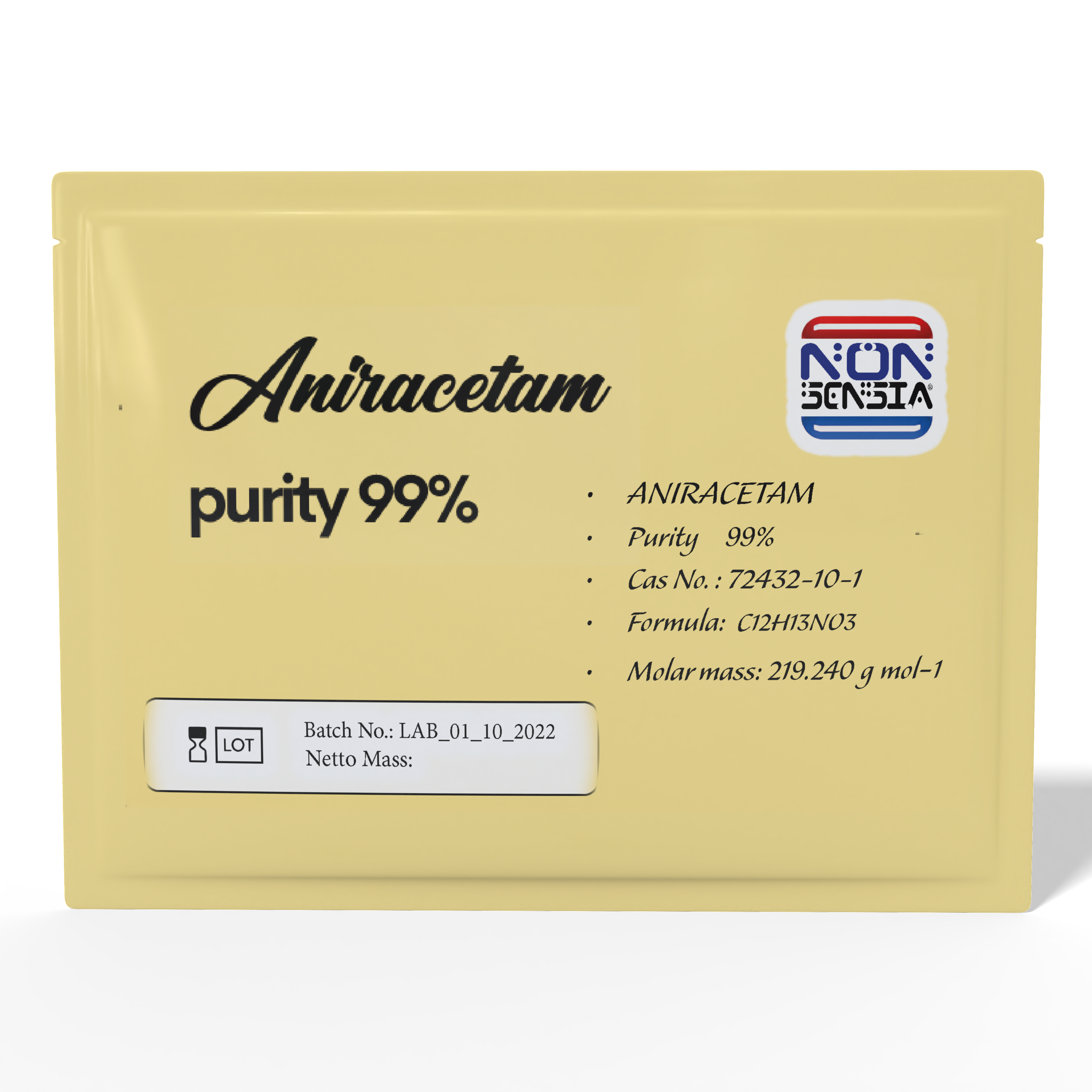
Aniracetam ≥99% – Analytical Reference Standard | CAS 72432-10-1
15,41 zł – 1892,12 złPrice range: 15,41 zł through 1892,12 zł
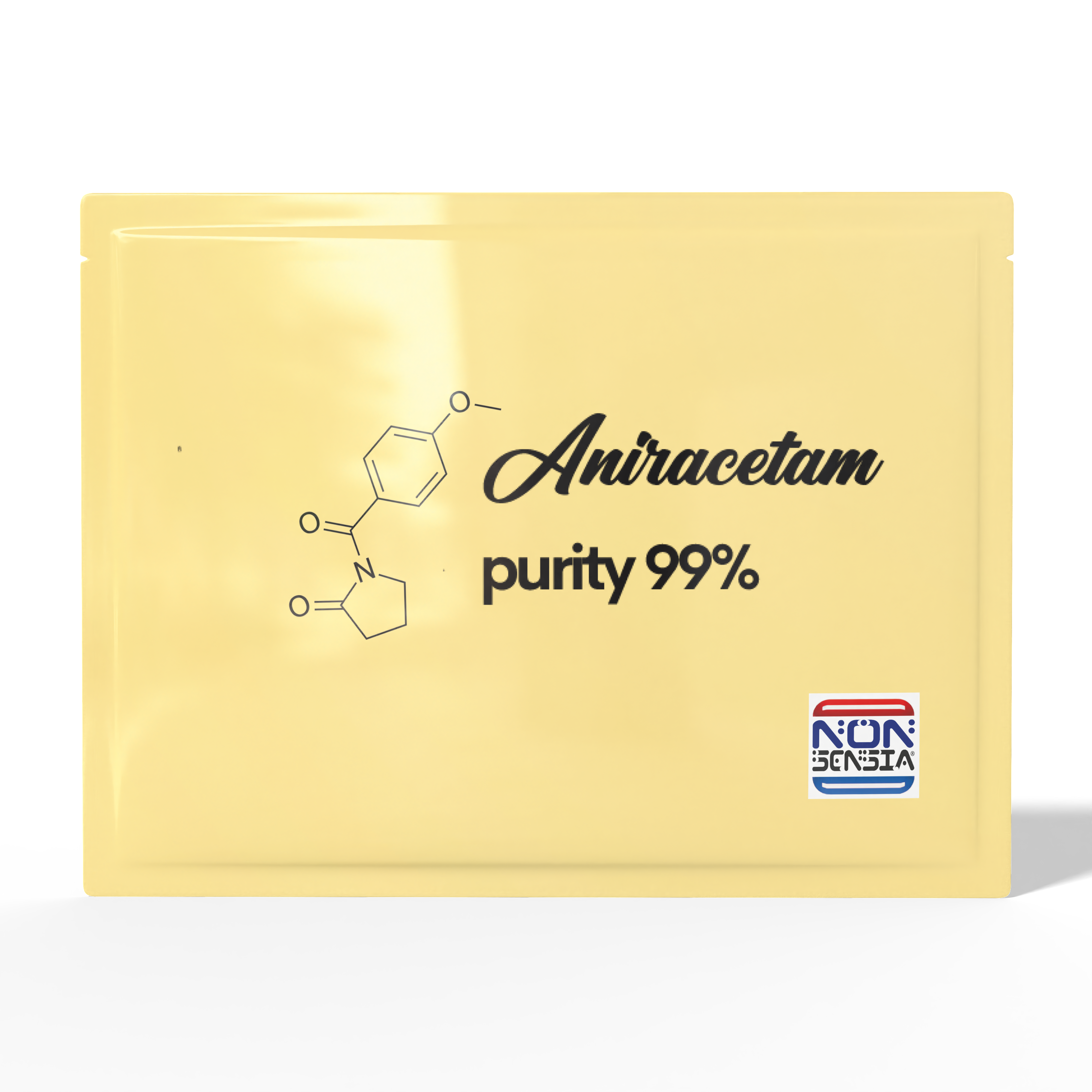
Aniracetam Reference Standard — CAS 72432-10-1, 1-(4-Methoxybenzoyl)pyrrolidin-2-one
N-Aroyl lactam supplied for identity confirmation, related-substances work and method development. Laboratory reagent and analytical reference material only — not for human or animal consumption, not a medicinal product, not registered as a medicine in Poland, and not approved for human use in the United States.
- Read this first: the base peak of the deposited tandem spectra at every ordinary collision energy, m/z 135.0441, is the anisoyl acylium cation C8H7O2+ — and it is shared by four different substances: the compound itself, its metabolite N-anisoyl-GABA, its degradation product 4-methoxybenzoic acid and its named process impurity. One ion, four identities. Only the precursor mass and the chromatography separate them
- CAS / CID / EC / UNII / ATC: 72432-10-1 · PubChem 2196 · 615-758-3 · 5L16LKN964 · N06BX11
- Formula / mass: C12H13NO3 · 219.24 g·mol−1 · monoisotopic 219.08954328 Da · [M+H]+ at m/z 220.0968 · InChIKey
ZXNRTKGTQJPIJK-UHFFFAOYSA-N - Independently corroborated: the compound is deposited as ligand 4MP in PDB entry 2AL5, a 1.65 Å X-ray structure — formula C12 H13 N O3, formula weight 219.237, resolved to atomic coordinates
- Stereochemistry: zero defined and zero undefined stereocentres of both types — achiral. There is no (R)- or (S)-aniracetam, no enantiomeric excess to specify and no optical rotation to measure. One of its named process impurities, however, is chiral
- Why it degrades: the ring nitrogen sits between two carbonyls, making this an imide rather than an amide. Hydrolysis gives 4-methoxybenzoic acid and 2-pyrrolidinone — both named related substances with their own registry records. Moisture, not temperature, is the controlling storage variable
- The degradant that gets missed: 2-pyrrolidinone has no aromatic chromophore and no anisoyl group, so it is invisible both to ultraviolet detection above 210 nm and to any method anchored on m/z 135. It is the complementary marker to everything else on the list
- Data gaps: the registry record holds no melting point, no boiling point, no density, no pKa, no measured logP and no solubility — its experimental section contains collision cross sections and nothing else. Figures for these constants circulate in commercial listings; they are not registry values
- Spectra: two electron-ionisation reference spectra, ten MassBank tandem records including a nine-point collision-energy ladder, one ATR infrared and one FT-Raman — but no 1H NMR, no 13C NMR, no 2D NMR and no ultraviolet spectrum
- Hazards: Warning, GHS08, H361 / Repr. 2 — from 3 company reports out of 2 notifications, one of which reports no hazard at all. Not harmonised, not legally binding
- Status: not on the WADA 2026 list, although the related fonturacetam is; not on the Polish controlled-substances list; no medicinal product registered in Poland; not scheduled in the United States. Each negative checked with a control that fired
Full registry data, the four-substance fragment analysis, the published separation conditions that name every related substance, an explicit list of what is and is not certified, and 43 cited sources are set out below.
Quick Payment
100% New
Fast Delivery
- Additional Information
Product classification — read before ordering. This item is a chemical reagent and analytical reference material. It is not a medicinal product, dietary supplement, food, feed, novel food or cosmetic, and it is not intended for human or animal consumption or for any in-vivo administration whatsoever. It is supplied exclusively to laboratories, research institutions and professional users for in-vitro analytical, chromatographic and method-development work. Scientific findings summarised on this page describe substances investigated in published laboratory and clinical research; they are reported here as bibliographic facts about that literature and are not product claims, dosage guidance, or a recommendation of any use of this reagent.
One fragment ion, four different substances. Read sections 4 and 7 before ordering. At every collision energy a laboratory would actually work at, the deposited tandem mass spectra of aniracetam have their base peak at m/z 135.044, the 4-methoxybenzoyl (anisoyl) acylium cation C8H7O2+ — in electron ionisation, in the quadrupole time-of-flight records, and at every nominal energy up to and including 90 % in the deposited nine-point collision-energy ladder [1][10][11]. Only above that does the spectrum collapse into low-mass hydrocarbon ions that identify nothing at all (section 5). That ion is not a property of aniracetam. It is a property of the anisoyl group, and the anisoyl group survives intact in the compound's principal metabolite N-anisoyl-GABA [2], in its hydrolytic degradation product 4-methoxybenzoic acid [3], and in the named chiral process impurity (p-anisoyl)-4-methyl-2-pyrrolidinone [15]. Four substances, one base peak, calculated exact mass 135.0441 for every one of them. An identification anchored on the base peak alone confirms the presence of an anisoyl group and nothing more. What separates the four is the precursor mass and the chromatography — and that is precisely what a characterised reference standard is for.
Key facts
- Substance
- Aniracetam (INN, USAN, JAN; INN-Latin aniracetamum); 1-(4-methoxybenzoyl)pyrrolidin-2-one; developed as Ro 13-5057
- CAS
- 72432-10-1 [1]
- EC / ECHA
- 615-758-3 · registry entry 100.108.230 [5]
- PubChem CID
- 2196 [1]
- UNII
- 5L16LKN964
- ATC
- N06BX11; veterinary QN06BX11 [6]
- Formula
- C12H13NO3
- Molecular mass
- 219.24 g·mol−1
- Monoisotopic mass
- 219.08954328 Da; protonated molecule [M+H]+ at m/z 220.0968
- InChIKey
ZXNRTKGTQJPIJK-UHFFFAOYSA-N- Stereocentres
- 0 defined, 0 undefined, of both atom and bond type — achiral (section 3)
- Diagnostic fragment
- m/z 135.0441, C8H7O2+ — base peak in electron ionisation and in every deposited tandem spectrum up to 90 % nominal collision energy, and shared with three related substances
- Computed descriptors
- XLogP3 1.6 (computed, not measured) · TPSA 46.6 Å2 · H-bond donors 0 · acceptors 3 · rotatable bonds 2 · heavy atoms 16 · complexity 282
- Melting point, density, pKa, solubility
- No experimental value in the registry record — the record's experimental section holds collision cross sections and nothing else (section 8)
- Deposited spectra
- Two electron-ionisation reference spectra, ten MassBank tandem records, four HMDB/GNPS tandem spectra, one ATR infrared, one FT-Raman. No 1H NMR, no 13C NMR, no 2D NMR, no ultraviolet (section 9)
- GHS
- Warning — GHS08; H361 (Repr. 2). Aggregated from 3 company reports arising from 2 notifications, one of which reports no hazard at all. No harmonised CLP Annex VI entry (section 12)
- WADA 2026
- Not listed. The related fonturacetam is listed, under S6.A [7] — see section 13
- Poland
- No medicinal product registered; not on the controlled-substances list [8][9]
- Pack sizes
- 1 g · 5 g · 10 g · 50 g · 100 g · 200 g
On this page
- What this material is
- Identity and registry codes
- Structure and stereochemistry
- One ion, four substances
- What the deposited mass spectra actually contain
- Methods that separate what the fragment merges
- The imide bond, and a compound that makes its own impurities
- Physicochemical data, and how much of it does not exist
- Spectra: what is deposited, what is missing
- A hard structural anchor: the ligand in PDB 2AL5
- What the published literature covers
- Hazard classification, and how narrow its basis is
- Regulatory status
- Handling and storage
- What we certify and what we do not
- Terms of supply
- Questions and answers
1. What this material is
This page describes aniracetam supplied as an analytical reference material: a weighed quantity of a single identified chemical substance, intended to serve as the point of comparison against which another sample is measured. A reference material has one job and it is a narrow one. When a laboratory reports that a powder is aniracetam, that a product marketed for cognition contains it, or that a synthesis batch meets a related-substances limit, the report is only as good as the material the instrument was calibrated against. The identity, the purity and the stability of one vial propagate into everything downstream.
Aniracetam is 1-(4-methoxybenzoyl)pyrrolidin-2-one: a five-membered lactam whose nitrogen carries an aroyl group in place of a hydrogen [1]. That single structural fact organises this entire page. The bond between the ring nitrogen and the aroyl carbonyl is an imide bond rather than an ordinary amide bond, and imides hydrolyse considerably more readily than amides do. Break it and two fragments result — 2-pyrrolidinone [4] and 4-methoxybenzoic acid [3] — both of them named, characterised compounds with their own registry records, and both of them entries on the related-substances list of the one published method that resolves the whole set [15].
The analytical difficulty follows directly. Three of the four substances a laboratory has to tell apart here — the parent compound, its principal metabolite, its degradation product and its named process impurity — carry the intact 4-methoxybenzoyl group, and all four therefore produce the same base peak in tandem mass spectrometry. Section 4 sets out what follows from that; section 7 sets out why the related substances form in the first place. Neither problem is solved by buying a purer powder. Both are addressed by holding material of confirmed identity and running a method that separates rather than merely detects.
Two things this compound is not difficult about are worth stating early, because commercial copy regularly asserts otherwise. It is achiral: zero stereocentres of any kind, so there is no enantiomeric purity to specify and no chiral column to buy (section 3). And it has no polymorph problem on record — which is not the same as having no polymorphs; the question appears not to have been investigated in anything we can find, and section 15 says so rather than filling the gap with a number.
For the general terms on which this shop supplies reference materials, the surrounding reference standards category collects the rest of the catalogue on the same basis.
2. Identity and registry codes
Every identifier below is quoted from a public registry, with the registry named. Aniracetam is unusually well provided for in this respect: the record carries more than thirty cross-references, an international nonproprietary name, an anatomical-therapeutic-chemical code and a Protein Data Bank ligand code, which together make identity confirmation on paper straightforward even where confirmation on the instrument is not.
| Preferred name | Aniracetam (INN, USAN, JAN); INN-Latin aniracetamum |
|---|---|
| CAS Registry Number | 72432-10-1 |
| EC number | 615-758-3 |
| ECHA registry entry | 100.108.230 [5] |
| PubChem CID | 2196 |
| UNII (FDA) | 5L16LKN964 |
| ChEBI | CHEBI:47943 |
| ChEMBL | CHEMBL36994 |
| DrugBank / DrugCentral | DB04599 / 221 |
| KEGG | D01883 (drug) and C13355 (compound) |
| DSSTox | DTXSID5045128 (substance) / DTXCID3025128 (compound) |
| HMDB | HMDB0248441 |
| NCI Thesaurus | C65236 |
| Nikkaji | J18.602C |
| MDL number | MFCD00153767 |
| Beilstein BRN | 4807205 |
| NSC number | NSC758223 |
| Metabolomics Workbench | 52471 |
| Guide to Pharmacology | 4133 |
| MeSH | M0111076 (aniracetam); M0111074 (Ro 13-5057) |
| Wikidata | Q417630 |
| ATC code | N06BX11, reached as N → N06 → N06B → N06BX → N06BX11; veterinary QN06BX11 [6] |
| PDB ligand / structure | 4MP in entry 2AL5 [13][23] — see section 10 |
| Development code | Ro 13-5057 (Roche); also written Ro-135057 and Ro 135057 |
| Historical trade names | Draganon, Ampamet, Memodrin, Reset, Sarpul, Sarpol — from the registry synonym list; none is currently registered in Poland (section 13) |
Two identifier traps worth knowing about
The trade name is Draganon, with a second A. The variant spelling Dragonan circulates in commercial listings and in product tagging, and it corresponds to nothing in the registry synonym list. A search on the misspelling returns supplier pages and little else; a search on the correct spelling returns the registry entry. This is the sort of error that survives indefinitely because it is copied rather than looked up, and it is worth checking against the synonym list before it lands on a certificate.
Two CAS-like numbers appear in the record's removed synonyms, and neither belongs to this substance. The record carries 1235-82-1 and 27670-93-5 among annotations that have since been withdrawn. Resolved independently, 1235-82-1 is biperiden hydrochloride and 27670-93-5 is menaquinone-12 — two compounds with no relationship to aniracetam whatsoever. They are the residue of depositor errors that the registry has corrected. Aniracetam has no deprecated CAS number at all, and a document quoting either of those two numbers for this substance is quoting a mistake rather than an older convention. Contrast mebicar, where two genuinely superseded CAS numbers exist and behave differently from one another — there, an old number on a certificate may be legitimate; here it never is.
On the CAS registry itself. Direct confirmation in CAS Common Chemistry now requires an API key, so we cannot quote that registry as a first-hand source. The confirmation available is indirect but sound: the compound record links out to commonchemistry.cas.org/detail?cas_rn=72432-10-1, and an independent lookup of the string 72432-10-1 resolves to CID 2196 with formula C12H13NO3 and molecular mass 219.24 [1]. We report the limitation rather than imply access we do not have.
Machine-readable descriptors
| IUPAC name | 1-(4-methoxybenzoyl)pyrrolidin-2-one |
|---|---|
| SMILES | COC1=CC=C(C=C1)C(=O)N2CCCC2=O |
| InChI | InChI=1S/C12H13NO3/c1-16-10-6-4-9(5-7-10)12(15)13-8-2-3-11(13)14/h4-7H,2-3,8H2,1H3 |
| InChIKey | ZXNRTKGTQJPIJK-UHFFFAOYSA-N |
| Molecular weight | 219.24 g·mol−1 |
| Exact / monoisotopic mass | 219.08954328 Da (both values identical in the record) |
| XLogP3 | 1.6 — computed (XLogP3 3.0, release 2025.09.15), not a measured partition coefficient |
| Topological polar surface area | 46.6 Å2 |
| Hydrogen-bond donors / acceptors | 0 / 3 |
| Rotatable bonds | 2 |
| Heavy atoms / complexity | 16 / 282 |
| Formal charge / covalently bonded units | 0 / 1 — a neutral free molecule, no counter-ion |
| Isotope atom count | 0 |
The InChIKey ends -UHFFFAOYSA-N. That suffix is not decoration: UHFFFAOYSA is the standard second block for a structure with no stereochemical and no isotopic layer to encode. Where tadalafil carries a second block that changes with each of its four stereoisomers, aniracetam has nothing to vary. A supplier document offering an aniracetam InChIKey with a different second block is describing a different substance, an isotopically labelled analogue, or an error.
Zero hydrogen-bond donors is the second descriptor worth pausing on. The molecule contains one nitrogen and three oxygen atoms and yet has no O–H and no N–H anywhere, because the ring nitrogen is fully substituted by the aroyl group. That has a practical consequence in infrared work: an N–H or O–H stretch in the 3200–3500 cm−1 region of a sample spectrum does not belong to aniracetam. It belongs to water, to a hydrolysis product, or to something else in the vial. Both hydrolysis products in section 7 carry such a bond; the parent carries none.
3. Structure and stereochemistry
The registry record states the stereochemistry of this molecule in four counters, and all four read zero [1]:
| Defined atom stereocentre count | 0 |
|---|---|
| Undefined atom stereocentre count | 0 |
| Defined bond stereocentre count | 0 |
| Undefined bond stereocentre count | 0 |
| InChI stereo layer | None — the InChI string terminates after the hydrogen layer |
| InChIKey second block | UHFFFAOYSA — the standard block for a structure carrying no stereo layer |
| Isotope atom count | 0 |
| Covalently bonded units | 1 — free molecule, no salt form |
Aniracetam is achiral. Not racemic, not unresolved, not a mixture awaiting separation — there is no enantiomer of aniracetam to separate. The pyrrolidinone ring carries no substituent that would break the local symmetry at any of its carbons, and the aromatic ring is para-substituted and therefore symmetric about its own axis. The distinction matters because the counters that would flag a problem read zero for two different reasons, and reading only one of them misleads. A count of zero defined centres beside a non-zero count of undefined centres means an unresolved chiral compound, which is a real and common situation. Here both counters read zero, which means there is nothing to resolve.
What this rules out. There is no such thing as (R)-aniracetam or (S)-aniracetam. There is no enantiomeric excess to specify, no chiral stationary phase to buy, no optical rotation to measure, and no racemisation pathway for the parent compound to worry about during storage. A certificate quoting a specific rotation for aniracetam, or a listing offering an "enantiomerically pure" grade, is describing something the molecule cannot possess. The same failure has attached to coluracetam, another achiral compound for which optical-rotation figures have circulated in marketing copy.
Where aniracetam sits among the racetams
Stereochemistry across this structural class is not uniform, and the contrast is a useful reminder that "racetam" names a ring, not a stereochemical situation. Every figure below is the registry's own stereocentre counter, read the same way for every compound:
| Compound | Formula | Defined / undefined atom stereocentres | Consequence |
|---|---|---|---|
| Aniracetam (CID 2196) | C12H13NO3 | 0 / 0 | Achiral; no chiral specification is possible |
| Piracetam (CID 4843) | C6H10N2O2 | 0 / 0 | Achiral |
| Pramiracetam (CID 51712) | C14H27N3O2 | 0 / 0 | Achiral |
| Coluracetam (CID 214346) | C19H23N3O3 | 0 / 0 | Achiral |
| Oxiracetam (CID 4626) | C6H10N2O3 | 0 / 1 | One stereocentre, unresolved in the registry record — a genuine chiral specification question |
| Fonturacetam (CID 132441) | C12H14N2O2 | 0 / 1 | One unresolved stereocentre; separately, this compound is on the 2026 anti-doping list [7] |
| Noopept (CID 180496) | C17H22N2O4 | 1 / 0 | One fully specified stereocentre |
Three different situations inside one structural family. Aniracetam and its achiral relatives need no chiral method at all. Oxiracetam and fonturacetam each carry a centre the registry has not resolved, which is an open specification question rather than a settled one. Noopept carries a centre that is specified, which makes a chiral purity figure both meaningful and checkable. Inferring any of these from the family name gives the wrong answer more often than the right one.
The chirality that is genuinely there, and it is not in the product
The parent compound is achiral; one of its named process impurities is not. The related-substances method for aniracetam names four compounds it must separate, and one of them is (p-anisoyl)-4-methyl-2-pyrrolidinone [15] — the same skeleton carrying a methyl group at C-4 of the ring. That methyl creates a stereocentre where the parent has none. Independently, the oxidation of N-(4-methoxybenzyl)-2-pyrrolidinones to the corresponding N-(4-methoxybenzoyl) compounds has been used specifically as a rapid entry to optically active 4-substituted analogues [16] — the same substitution pattern, reached deliberately rather than as a by-product. The chirality question for this material is therefore inverted relative to the usual one. It is not "which enantiomer of the product am I holding". It is "is a chiral impurity present, and would my method see it".
A structure search on the SMILES corresponding to that impurity, COC1=CC=C(C=C1)C(=O)N1CC(C)CC1=O, returns CID 0 — the registry holds no compound record for it. It has no CAS number we can quote, no deposited spectrum and no registry identity of any kind. It exists in the literature as a named entry on a related-substances list [15] and, as far as the public record reaches, nowhere else. Its calculated composition is C13H15NO3, monoisotopic mass 233.10519 Da, protonated molecule at m/z 234.1125 — exactly 14.0157 Da above aniracetam, the mass of a methylene group. That offset is the good news in section 4: the precursor mass does separate this one, even though the base peak does not.
Conformation is not configuration
One further structural point, because it is regularly conflated with stereochemistry. The imide bond between the ring nitrogen and the aroyl carbonyl has restricted rotation, in the way that amide bonds do, and the preferred conformation of the molecule in the solid state and in solution was the subject of a dedicated structural study combining crystallographic and dipole-moment evidence [17][18]. Restricted rotation about a single bond produces rotamers — conformational isomers that interconvert — not configurational stereoisomers. They can broaden NMR signals and complicate a variable-temperature experiment. They do not create enantiomers, they do not appear in the registry's stereocentre counters, and no chiral column would resolve them. The four zeros are correct, and the rotamer literature does not contradict them.
4. One ion, four substances
This is the central analytical fact about aniracetam as a reference material, and it deserves stating in the bluntest available terms.
At every collision energy at which a tandem method is normally run, the base peak in the deposited spectra of aniracetam is m/z 135.044 — and it is not diagnostic of aniracetam. The ion is the 4-methoxybenzoyl acylium cation, C8H7O2+, calculated exact mass 135.0441 Da. It arises by cleavage of the bond between the aroyl carbonyl and whatever heteroatom is attached to it. Four substances in this compound's immediate family carry that aroyl group intact and therefore give the same ion: the parent compound itself, its principal metabolite, its hydrolytic degradation product, and its named process impurity. A tandem method that identifies aniracetam by the presence of m/z 135.044 will report the same answer for all four.
| Substance | Role | Formula / registry | Precursor [M+H]+ |
|---|---|---|---|
| Aniracetam | the product on this page | C12H13NO3 · CID 2196, CAS 72432-10-1 [1] | m/z 220.0968 |
| N-Anisoyl-GABA (4-p-anisamidobutyric acid) | principal metabolite; the lactam ring opened | C12H15NO4 · CID 155723, CAS 72432-14-5, EC 880-507-9 [2] | m/z 238.1074 |
| 4-Methoxybenzoic acid (p-anisic acid) | hydrolytic degradation product; one of two halves | C8H8O3 · CID 7478 [3] | m/z 153.0546, losing water directly to 135.0441 |
| (p-Anisoyl)-4-methyl-2-pyrrolidinone | named process impurity; chiral | C13H15NO3 · no registry record [15] | m/z 234.1125 (calculated) |
Read the last column rather than the third. The precursor masses differ; the product ion does not. That is the whole of the practical guidance in this section, and it points in an unambiguous direction: a method that selects a precursor and reports a product ion is sound, a method that scans for a product ion and reports an identity is not. In a targeted multiple-reaction-monitoring experiment the transition 220.0968 → 135.0441 is specific because the precursor is specific. In a full-scan or data-dependent workflow where the base peak drives the library match, all four substances land on the same answer.
Why 2-pyrrolidinone is the useful counter-marker
The fourth related substance on the same published list is the other half of the hydrolysis, 2-pyrrolidinone [4], and it does not contain the anisoyl group. Formula C4H7NO, monoisotopic mass 85.05276 Da, protonated molecule at m/z 86.0600. It is invisible to any method anchored on 135.044, which makes it the complementary marker rather than a competing one: if 2-pyrrolidinone is present in a sample of aniracetam, hydrolysis has occurred, and it has occurred whether or not the anisoyl-derived signals look normal. The two hydrolysis halves therefore behave in opposite ways in the mass spectrometer, and looking for both is worth more than looking harder at either.
An honest note on what has been checked and what has been reasoned. The base peak of aniracetam at m/z 135.044 is deposited data, from named laboratories on named instruments [1][10][11]. The assignment of that ion to C8H7O2+ is arithmetic: the calculated exact mass of that cation is 135.04406 Da, within a part per million of the deposited measurements. The statement that the other three substances give the same ion follows from structure and from the general behaviour of aroyl compounds under collisional activation — all three retain the intact 4-methoxybenzoyl group, and the acylium is the expected primary cleavage. We flag it as structural reasoning, not as four deposited spectra, because it is not four deposited spectra. Section 9 explains why it cannot be: the metabolite's registry record holds no spectral information at all.
The same elemental composition turns up elsewhere in this catalogue
There is a further coincidence worth knowing about, because it crosses compound families entirely. The deposited high-resolution tandem spectrum of tadalafil also has its base peak near m/z 135.04, assigned to the methylenedioxybenzyl cation from the benzodioxole ring [12]. That cation is also C8H7O2+. Two structurally unrelated compounds, in two different sections of the same catalogue, share a base peak of identical elemental composition and therefore identical exact mass. The deposited values differ — 135.0439 for aniracetam in the collision-energy ladder and 135.0433 for tadalafil in the Orbitrap record where that ion is the base peak, a spread of about four parts per million. A second deposited tadalafil spectrum, in which the ion is not the base peak, reads 135.0423, some thirteen parts per million below the calculated value. That scatter is a property of independent depositions on different instruments, not a chemical difference. No mass resolution separates two ions of the same composition, because there is nothing there to resolve.
The lesson generalises past both compounds. A fragment ion of composition C8H7O2+ is a marker for an eight-carbon, seven-hydrogen, two-oxygen fragment. That description covers a methoxybenzoyl group and a methylenedioxybenzyl group and any number of other arrangements. Treating it as a compound identifier confuses a class marker for an identity, which is the same error the analyte-specific literature has been warning about for a decade in the adulterated-supplement context [19][21].
5. What the deposited mass spectra actually contain
Aniracetam is well served by deposited spectra, which is not true of every compound in this catalogue — chlodantane, at the opposite extreme, has none of any kind. The tandem records here are numerous, attributed and, in one case, resolved across a full ladder of collision energies. That ladder is worth reading in detail because it shows exactly where the identification problem starts.
| Record | Conditions | What it reports |
|---|---|---|
| NIST #408570, main library [1] | Electron ionisation, 85 peaks; depositor NIST Mass Spectrometry Data Center; spectrum from Chemical Concepts, a Wiley division, Weinheim | Base peak m/z 135; second m/z 77; third m/z 219 (the molecular ion) |
| NIST #190256, replicate library [1] | Electron ionisation, 68 peaks; same depositor and same spectrum source | Identical ordering: 135, then 77, then 219 |
MassBank MSBNK-ACES_SU-AS000555 [10] | Exploris 480 Orbitrap; LC-ESI-QFT, MS2, positive; HCD ramp 20–70 % nominal; Waters Acquity UPLC BEH C18, 3.0 × 100 mm, 1.7 µm; retention 8.68 min; authors ACESx, National Facility for Exposomics; licence CC BY | Precursor 220.0964 [M+H]+; top peaks 135.04385, 220.09631, 143.03371, 136.04688, 101.02351 |
MassBank MSBNK-Eawag-EQ01164901 to …09 [11] | Exploris 240 Orbitrap; LC-ESI-QFT, MS2, positive; XBridge C18, 3.5 µm, 2.1 × 50 mm; retention 4.731 min; nine nominal collision energies at 15, 30, 45, 60, 75, 90, 120, 150 and 180 %; authors B. Beck and J. Hollender; licence CC BY-SA | Precursor 220.0968 [M+H]+; a complete energy ladder from a near-single-fragment spectrum to a low-mass-rich one |
| HMDB / GNPS spectra 374215, 374814, 450614, 451500 [1] | LC-ESI-qTOF, positive; depositor Human Metabolome Database | Top peaks include 135.0446 / 135.0435, 136.0479, 220.0976, 107.0490, 92.0249 |
MoNA CCMSLIB00000078081 [1] | qTOF, MS2, positive, precursor type [M+H]+ | Precursor m/z 220.097 |
The fragmentation cascade, and what it is made of
The product ions are consistent across instruments and across ionisation modes, and every one of them is accounted for by loss of small neutrals from the anisoyl cation. Calculated exact masses are given beside the assignments so the arithmetic can be checked rather than trusted:
| m/z | Composition | Origin |
|---|---|---|
| 220.0968 | C12H14NO3+ | Protonated molecule [M+H]+; survives as a significant peak only at low collision energy |
| 219 | C12H13NO3+• | Molecular radical cation in electron ionisation; third most intense peak |
| 135.0441 | C8H7O2+ | Anisoyl acylium. Base peak in electron ionisation, in the qTOF records, and at every nominal collision energy up to 90 % in the deposited ladder; it falls to about 12 % of the base peak at 120 % and is absent at 150 % and above. The subject of section 4 |
| 107.0491 | C7H7O+ | Loss of carbon monoxide from 135.0441 — the methoxyphenyl cation |
| 92.0257 | C6H4O+• | Loss of a methyl radical from 107.0491 |
| 77.0386 | C6H5+ | Phenyl cation; second most intense peak in electron ionisation |
| 64.0308 | C5H4+• | Loss of carbon monoxide from 92.0257; appears only at high collision energy |
| 63.0229 / 51.0229 | C5H3+ / C4H3+ | Low-mass hydrocarbon ions; dominate the spectrum only at 120–180 % nominal energy |
Trace that cascade back and it becomes obvious why it does not help with identity. Every ion in the list after the precursor derives from the aromatic half of the molecule. The pyrrolidinone ring contributes essentially nothing that survives collisional activation. A method built on these transitions is, structurally speaking, a method for anisoyl compounds with an aniracetam-shaped precursor filter in front of it — and if the precursor filter is wide, or absent, the specificity goes with it.
Why the Eawag energy ladder is the most useful record in the set. Nine spectra of one compound, on one instrument, at nine collision energies, deposited together under an open licence [11]. At the lowest energies the spectrum is close to a single fragment; by the highest it is dominated by ions below m/z 100 that carry no structural information at all. For method development that ladder answers a question no single spectrum can: at what collision energy does this compound stop reporting anything specific. For a laboratory setting up transitions on a triple quadrupole, that is more useful than another confirmatory spectrum at one energy would be.
Collision cross sections: the only experimental data the registry holds
The experimental-properties section of the compound record contains exactly one class of measurement, and it is not the one anybody expects. There is no melting point, no solubility, no density and no measured partition coefficient (section 8). What there is, is four collision cross sections [1]:
| Adduct | CCS (Å2) | Type | Calibration |
|---|---|---|---|
| [M+H]+ | 145.49 | TW (travelling wave) | polyalanine and drug standards |
| [M+H]+ | 146.6 | TW | polyalanine and drug standards |
| [M+K]+ | 154.67 | TW | polyalanine and drug standards |
| [M+Na]+ | 156.31 | TW | polyalanine and drug standards |
Two independent determinations for the protonated molecule differ by 1.1 Å2, roughly 0.8 %, which is about what travelling-wave calibration typically delivers and is worth knowing before anyone treats a cross section as a tight identity criterion. Ion mobility is nonetheless a genuine second dimension here, and one of the few available: it separates on shape rather than on mass, so in principle it responds to the difference between aniracetam and its ring-opened metabolite even where the fragment does not. We are not aware of a published mobility method that does this for these four substances, and we are not going to describe one that does not exist.
6. Methods that separate what the fragment merges
Section 4 leaves one conclusion standing: identity for this compound has to come from separation or from precursor selection, not from the product-ion spectrum. Four documented approaches address that, and all four have published methods.
The related-substances method, which names all four compounds
The single most useful paper for anyone handling this material is a validated liquid-chromatographic method developed specifically for the simultaneous determination of aniracetam and its related substances in bulk drug and in a tablet formulation [15]. Its value is not the validation statistics but the target list: it names 2-pyrrolidinone, 4-methoxybenzoic acid, 4-p-anisamidobutyric acid (N-anisoyl-GABA) and (p-anisoyl)-4-methyl-2-pyrrolidinone as the substances that must be resolved. That is the four-substance problem of section 4 stated as a chromatographic requirement rather than as a caution.
| Column | Hypersil BDS-CN, 150 × 4.0 mm, 5 µm — a cyanopropyl phase, not C18 |
|---|---|
| Mobile phase A | Phosphate buffer, pH 4.0, 0.010 M |
| Mobile phase B | Acetonitrile / phosphate buffer pH 4.0, 90:10 v/v |
| Elution | Gradient |
| Flow rate | 1.0 mL min−1 |
| Run time | Approximately 20 min including re-equilibration |
| Detection | Ultraviolet at 210, 250 and 280 nm |
| Injection / temperature | 20 µL; ambient |
Three details in that table repay attention. The stationary phase is cyanopropyl rather than octadecyl, a deliberate choice for a set of analytes spanning a free carboxylic acid, a small polar lactam and two aroyl compounds — C18 struggles at the polar end of that range. The buffer is at pH 4.0, which keeps 4-methoxybenzoic acid protonated and therefore retained instead of eluting near the void. And detection is at three wavelengths simultaneously, because the four analytes do not share a chromophore: the two anisoyl compounds and the free acid absorb in the 250–280 nm region, whereas 2-pyrrolidinone has essentially nothing to detect above 210 nm. A single-wavelength method will see some of these substances and miss others.
Ultraviolet detection: adequate here, and worth appreciating
Aniracetam has a real chromophore. The 4-methoxyphenyl ketone is a conjugated aromatic system with substantial absorbance in the accessible ultraviolet, which is why the published methods use ordinary diode-array detection and get away with it. This is not something to take for granted across a catalogue: mebicar has no useful chromophore at all and is invisible on the same instrument, and alpha-GPC is in a similar position. At the other extreme methylene blue absorbs so strongly in the visible that dilution rather than detection is the problem. Aniracetam sits comfortably in the workable middle, and that is a genuine practical advantage of this compound over several of its neighbours.
It is also, however, the reason the missing ultraviolet spectrum in section 9 is irritating rather than academic. The published methods quote detection wavelengths; none of them deposits the spectrum those wavelengths were chosen from. A laboratory that wants to know the actual absorption maximum, or the molar absorptivity needed for a concentration check without a calibration curve, has to measure it.
Spectrophotometric and spectrofluorimetric routes
Two further families of method exist for this compound and both are worth knowing about, because both are cheap. Simple spectrophotometric methodologies have been developed for the analysis of two mixtures containing racetams in pharmaceutical preparations [24], and a spectrofluorimetric study has characterised the quenching of tyrosine and L-tryptophan fluorescence by aniracetam using Stern–Volmer and double-logarithmic treatments [25]. A separate liquid-chromatographic method addresses content determination of aniracetam in an inclusion complex [26]. None of these is a general identity method — a quenching constant is not an identifier — but each is a route to a quantitative figure without a mass spectrometer in the room.
Bioanalytical methods, which exist for the metabolite in its own right
The metabolite is analytically significant enough to have attracted dedicated methods twice, two decades apart: a high-performance liquid chromatographic determination of aniracetam and N-anisoyl-GABA in human plasma [27], and a later liquid chromatography–tandem mass spectrometry method for the metabolite alone, applied to a pharmacokinetic study [28]. A separate bioequivalence study used liquid chromatography with mass-spectrometric detection on two capsule formulations [29]. That the metabolite has its own methods is the strongest available evidence that the four-substance problem in section 4 is a working analytical problem rather than a theoretical one — nobody develops a dedicated method for a compound that the parent method already resolves.
What every one of these methods needs. The related-substances method needs a standard of each analyte to assign the peaks. The bioanalytical methods need a standard to fix retention and response. The spectrophotometric methods need a standard to build the calibration. None of them is self-calibrating, and none of them can tell you which of the four anisoyl-bearing substances you are holding without something of known identity to compare against. That is what an analytical reference standard is for, and it is why the identity statement on a certificate is not a decorative detail.
7. The imide bond, and a compound that makes its own impurities
Sections 4 and 6 describe the consequence. This section describes the cause, because it determines how the material should be stored and what a stability-indicating method has to look for.
The nitrogen of the pyrrolidinone ring carries an aroyl group. A nitrogen flanked by two carbonyls — the ring's own lactam carbonyl on one side, the aroyl carbonyl on the other — is an imide nitrogen, and the electron density that would normally stabilise an amide bond is shared between two competing carbonyls instead of one. The practical result is that the exocyclic C–N bond is markedly more electrophilic, and therefore more readily hydrolysed, than an ordinary amide bond of similar appearance.
| Cleavage | Products | Where they show up |
|---|---|---|
| Exocyclic C–N bond, hydrolytic | 4-Methoxybenzoic acid [3] + 2-pyrrolidinone [4] | Both are named related substances in the pharmacopoeial-style method [15]. Both have their own registry records |
| Lactam ring, hydrolytic or enzymatic | N-Anisoyl-GABA [2] — the aroyl group retained, the ring opened to a free amino acid chain | The principal metabolite; has its own dedicated bioanalytical methods [27][28] |
| Neither — introduced during synthesis | (p-Anisoyl)-4-methyl-2-pyrrolidinone [15] | Process impurity; chiral; no registry record (section 3) |
Two of those three rows describe the same molecule arriving by different routes. 2-Pyrrolidinone is simultaneously a hydrolytic degradation product of aniracetam and a reported metabolite of it, and it has been studied in its own right as an active species [30]. The distinction between "degradant" and "metabolite" is a distinction about where the reaction happened, not about what was produced. For a laboratory holding a vial, only the first matters: the same compound that a biological system generates from this molecule can also form in the container.
The storage consequence, stated plainly. This compound's principal degradation pathway is hydrolysis, so the controlling storage variable is moisture, not temperature. Keep the container dry and closed. The published stability work that exists for this molecule — a twelve-week design-of-experiments study varying relative humidity and temperature on a cyclodextrin formulation, with infrared changes observed over the period [20] — was carried out on a formulated complex rather than on the neat solid, so it does not transfer directly. It is nonetheless the only systematic stability dataset we can point to, and its choice of variables is informative in itself: relative humidity was one of the two factors the authors thought worth varying.
How this differs from ester hydrolysis
The comparison worth drawing is with the local anaesthetic esters in this catalogue. Procaine hydrochloride and benzocaine are para-substituted benzoate esters, and their hydrolysis is the textbook example of a reference material degrading into an aromatic acid and an alcohol or amine. Aniracetam does the analogous thing across a nitrogen instead of an oxygen, which is slower but not by as much as the amide/ester intuition suggests, precisely because the imide activation closes part of the gap. The analytical signature is the same in both families: an aromatic acid accumulating in the vial, detectable at a different retention time and a different ultraviolet maximum from the parent, and invisible to any method that only looks where the parent elutes.
What a stability-indicating check should look for
The four related substances are not equally easy to see, and a check that finds only the easy ones gives false comfort:
| Substance | Ultraviolet | Tandem MS on 135.044 | Practical note |
|---|---|---|---|
| 4-Methoxybenzoic acid | Strong, aromatic | Yes — via water loss from [M+H]+ | Easy to see; retention depends critically on mobile-phase pH because it is ionisable |
| N-Anisoyl-GABA | Strong, aromatic | Yes | Easy to see; also ionisable, so pH-sensitive retention |
| (p-Anisoyl)-4-methyl-2-pyrrolidinone | Strong, aromatic | Yes | Elutes close to the parent; distinguished by a precursor 14 Da higher. No reference standard is commercially catalogued under a registry number |
| 2-Pyrrolidinone | Weak — no aromatic chromophore; needs 210 nm | No — contains no anisoyl group | The one that gets missed. Invisible to both of the convenient detection modes at once |
That last row is the reason the published method detects at 210 nm as well as at 250 and 280 [15]. A stability check that monitors only the aromatic wavelengths, or that relies only on the anisoyl transition, will report every anisoyl-bearing degradant faithfully and silently ignore half of the hydrolysis. Both halves form together, so the missing half is a directly usable cross-check on the detected one.
8. Physicochemical data, and how much of it does not exist
This section is short in numbers and long in caveats, which is an accurate reflection of the public record. The experimental-properties section of the compound record contains collision cross sections and nothing else [1]. That was verified by listing the record's full table of contents programmatically rather than by searching its text: the headings Melting Point, Solubility, Boiling Point, Density and Physical Description do not appear in the tree at all. The absences below are therefore real absences, confirmed against an instrument known to be reading the right document.
| Property | Status |
|---|---|
| Melting point | No value in the registry record. The section does not exist |
| Boiling point | No value. Section does not exist |
| Density | No value. Section does not exist |
| Vapour pressure | No value |
| Water solubility | No value in the registry record. One literature figure exists and it is a complexed value — see below |
| Partition coefficient | No measured value. XLogP3 = 1.6 is computed, from an algorithm, and must not be quoted as measured |
| pKa | No value. Consistent with the structure: there is no ionisable proton in the molecule |
| Physical description, colour, odour | No entry of any kind |
| Collision cross sections | Four values, travelling-wave, polyalanine-calibrated (section 5) |
| Biological half-life | 1–2.5 h, from the record's pharmacology section [1] — a bibliographic fact about the literature, not a property of this article |
Melting points, densities and solubility tables for this compound circulate widely in commercial listings. None of them has a source we can reach. That is a statement about what is publicly documented, not a claim that the numbers are wrong — someone somewhere may well have measured them. But a figure without a traceable measurement is not a specification, and repeating one on a reference-standard page would be putting our name to somebody else's arithmetic. If you measure a melting point on this material, you will have generated a datum that is not currently in the public record.
The one solubility figure with a citation behind it
A single quantitative solubility value for aniracetam exists in the peer-reviewed literature, and it is not a value for aniracetam in water. A formulation study designed a 2-hydroxypropyl-β-cyclodextrin complex and reported, by phase-solubility analysis, a solubility of 36.44 mg mL−1 for the complexed compound, described as an increase of 819 % over the uncomplexed material [20]. The same authors characterise the compound qualitatively as "greatly limited in its application by low aqueous solubility and a poor oral bioavailability".
It is arithmetically tempting to divide 36.44 by 9.19 and publish the quotient as the intrinsic aqueous solubility. We are not going to. The authors did not state an intrinsic figure, a percentage increase reported in a formulation paper need not be a simple ratio of two solubilities measured under identical conditions, and a derived number presented as a source value is exactly the sort of thing that then gets cited by somebody else as measured. What the literature supports is: low aqueous solubility, qualitatively described; 36.44 mg mL−1 when complexed with the cyclodextrin. Anything more precise about the neat compound in water would be ours rather than theirs.
What the computed descriptors are good for anyway
Absent measurements, the computed descriptors still constrain practical decisions, provided they are labelled correctly. XLogP3 of 1.6 places the compound as moderately lipophilic — it will retain properly on a C18 column, unlike the strongly hydrophilic compounds in this catalogue, and unlike them it needs no exotic stationary phase for ordinary work. Topological polar surface area of 46.6 Å2 and three hydrogen-bond acceptors with zero donors describe a molecule that dissolves readily in polar aprotic and moderately polar organic solvents and poorly in water, which is consistent with both the qualitative literature description and the cyclodextrin result. Two rotatable bonds mean a fairly rigid molecule, which is why its infrared and Raman spectra are sharp.
All of that is inference from computed values, and it is offered as a starting point for solvent selection rather than as data. Determine the solubility you need on the material in front of you.
9. Spectra: what is deposited, what is missing
The spectral picture for aniracetam is lopsided. Mass spectrometry and vibrational spectroscopy are well covered, with clean attribution. Nuclear magnetic resonance and ultraviolet spectroscopy are not covered at all.
| Technique | What exists | Attribution |
|---|---|---|
| Electron-ionisation MS | Two reference spectra, 85 and 68 peaks | NIST #408570 and #190256; depositor NIST Mass Spectrometry Data Center; spectra from Chemical Concepts, a Wiley division, Weinheim |
| Tandem MS, high resolution | Ten MassBank records under the InChIKey, including a nine-point collision-energy ladder | ACESx National Facility for Exposomics [10]; Eawag, B. Beck and J. Hollender [11]; open licences |
| Tandem MS, qTOF | Four HMDB / GNPS spectra plus one MoNA record | Human Metabolome Database |
| ATR infrared | One spectrum, attenuated total reflectance, neat | Bio-Rad FTS instrument, DuraSamplIR II; spectrum from Forensic Spectral Research; sample from Sigma-Aldrich, catalogue A9950, lot 056K3797V [14] |
| FT-Raman | One spectrum | Forensic Spectral Research; sample from Sigma-Aldrich, catalogue A9950, lot 056K3797V |
| 1H NMR | None deposited | — |
| 13C NMR | None deposited | — |
| Two-dimensional NMR | None deposited | — |
| Ultraviolet / visible | None deposited, despite published methods quoting 210, 250 and 280 nm as detection wavelengths [15] | — |
A control on the absences. The strings NMR and UV both occur in the record. Each occurs four times, and in every case within descriptive prose about sections or in the description of a spectral-database source — never as deposited data. That was checked in context rather than by counting occurrences, because a bare count would have returned four hits for each and read like a positive result. The zeros above are zeros in the data, not failures of the search.
Why the infrared and Raman attribution is unusually good, and why it is still one datum
Both vibrational spectra name the sample they were recorded on down to the lot number: Sigma-Aldrich catalogue A9950, lot 056K3797V. That level of traceability is rare in deposited spectral data and it is genuinely valuable — a laboratory comparing its own spectrum against the deposited one knows exactly what the deposited one was measured on.
It cuts the other way too. The infrared and the Raman spectra are two techniques applied to one sample from one supplier lot. They are not two independent confirmations of the compound's vibrational behaviour; they are one material examined twice. Vibrational spectroscopy is also the family most sensitive to solid form, and the solid-form question for this compound is entirely open (section 15). A laboratory whose material happens to be a different solid form from lot 056K3797V may see genuine differences in band positions and relative intensities without holding a different substance.
The missing NMR spectra, and why the absence bites
For most compounds a missing proton spectrum is an inconvenience. Here it is worse than that, for a specific reason. Section 4 established that mass spectrometry cannot distinguish the parent from three related substances on the product ion, and section 6 established that the separation methods all need a standard. Nuclear magnetic resonance is the technique that would settle the question without any of that machinery — the four substances differ conspicuously in their proton spectra, most obviously in whether an exchangeable proton is present at all. Aniracetam has none. 4-Methoxybenzoic acid has a carboxylic proton. N-Anisoyl-GABA has both an amide N–H and a carboxylic proton. The chiral impurity has a methyl doublet where the parent has none.
Those are predictions from structure, not deposited data, and section 15 labels them as such. But they are the reason to record a proton spectrum on the material you hold and archive it. Nothing public will do that job for you.
The catalogue contrast is instructive. Chlodantane has no deposited spectrum of any kind, so the gap there is total. Mebicar has proton and carbon spectra but no condensed-phase infrared, so the burden falls the opposite way. Aniracetam has excellent mass and vibrational data and no NMR whatsoever. Three different compounds, three different missing halves — and in each case the missing half is the one that would answer the identity question the other half cannot.
10. A hard structural anchor: the ligand in PDB 2AL5
Every other section of this page deals in registry entries, deposited spectra and published methods. There is one further piece of evidence for this molecule that is of a different kind altogether, and it is worth setting out separately because it is the most concrete confirmation of structure available anywhere in the public record.
Protein Data Bank entry 2AL5 is an X-ray diffraction structure at 1.65 Å resolution, titled Crystal structure of the GluR2 ligand binding core (S1S2J) in complex with fluoro-willardiine and aniracetam [13]. It was determined as part of a study of the mechanism by which positive allosteric modulators act on AMPA receptors [23]. The bound small molecule is deposited under ligand code 4MP, and the chemical-component record for that ligand reads:
| Ligand name | 1-(4-methoxybenzoyl)-2-pyrrolidinone |
|---|---|
| Formula | C12 H13 N O3 |
| Formula weight | 219.237 |
| Entries containing it | 2AL5 (X-ray diffraction, 1.65 Å) and 3LSW |
Compare those three values against the key facts at the top of this page. The name is the systematic name of aniracetam written the other way round. The formula is identical. The formula weight, 219.237, is the registry's 219.24 carried to one more decimal place. This is the molecule, resolved to atomic coordinates, deposited by a named laboratory, in a structure that anyone can download.
What this does and does not establish. It establishes the connectivity and the composition of the compound beyond any argument — a 1.65 Å structure with the ligand modelled into density is not a database annotation that could have been copied wrong. It also confirms, independently of the registry counters in section 3, that there is no stereochemistry to specify: the deposited component carries no chiral centre. What it does not establish is anything about the solid form of the neat compound, because the molecule here is bound in a protein site rather than in its own lattice. The crystal structure of aniracetam as a solid is a separate question, and section 15 records it as unexamined rather than absent.
The practical use of this anchor is narrow but real. Where a supplier document, a database import or a legacy record disagrees with the formula or the mass on this page, 2AL5 is a third independent source that settles the arithmetic without needing either of the other two. Few compounds in this catalogue have that. Apigenin is one of the others, for the same reason — it appears as a bound ligand in multiple deposited structures. Most reference materials never turn up in a protein crystal at all.
11. What the published literature covers
This section describes the research literature about the substance. It is a description of what has been published, offered as bibliography. Nothing in it is a claim about the article supplied on this page, and nothing in it is guidance about using anything.
Origin and class
Aniracetam was developed under the code Ro 13-5057 and belongs to the 2-pyrrolidinone family whose chemistry and structure–activity relationships were reviewed comprehensively in 1994 [22]. Pharmacological monographs appeared through the early 1990s [34], alongside a companion account of preclinical toxicology and safety [35], and a review in the Adis monograph series [33]. A later review considered the compound's pharmacology in the light of subsequent findings [32].
Mechanism
The mechanistic literature centres on the compound's action at AMPA-type glutamate receptors. A 1991 report described modulation of the time course of fast excitatory postsynaptic currents and of glutamate channel kinetics [31]; the structural work behind the current understanding, including the 2AL5 coordinates discussed in section 10, followed in 2005 [23]. Effects on cortical monoamine release via cholinergic and glutamatergic mechanisms have been reported in a hypertensive rat strain [38], and one of the compound's own metabolites, 2-pyrrolidinone, has been reported to induce long-term enhancement of receptor responses through a calcium/calmodulin-dependent kinase pathway [30] — which returns the discussion to section 7, where the same compound appears as a degradation product.
Disposition and metabolites
Pharmacokinetic work in rats characterised the parent compound and its metabolites, first systemically [37] and then in brain tissue [36]. The metabolite of principal interest throughout is N-anisoyl-GABA, and both of the dedicated bioanalytical methods cited in section 6 exist because of it [27][28]. The record's own pharmacology section gives a biological half-life of 1–2.5 h [1].
Human studies
Human investigation of this compound is historical rather than current. A scopolamine-challenge study in healthy volunteers compared aniracetam and piracetam [39]; clinical work in elderly patients with mental deterioration was published in Italian in 1991 [40]. A multiple-treatments meta-analysis of pharmacological treatment for cognitive dysfunction in dementia includes the compound among the agents compared [41]. A 2024 paper proposes a mechanistic model relating the compound to amyloid-beta accumulation [43]; it is a hypothesis paper and is cited here as such rather than as evidence. Recent animal work has examined behaviour in adolescent mice [42].
The one piece of literature that bears directly on why this page exists. A 2021 study applied untargeted liquid chromatography with quadrupole time-of-flight mass spectrometry to ten products sold for cognition and reported five unapproved drugs among them, aniracetam included [19]. Two findings from that paper are worth quoting precisely. Up to 502 ± 0.8 mg of aniracetam was measured in a single labelled portion of one product. And of twelve declared quantities checked against measurement, nine were wrong — some substances declared on a label were not detected, and some substances detected were not declared. A follow-up paper by the same group made a parallel finding for a different unapproved compound in the same product category [21].
That is a description of a market, not of this reagent. Its relevance here is analytical: those laboratories found what they found because they used untargeted high-resolution mass spectrometry with authentic reference materials behind the identifications, rather than a targeted method that reports what it was told to look for. Section 4 explains what happens when the reference material behind such an identification is not what it says it is.
12. Hazard classification, and how narrow its basis is
| Signal word | Warning |
|---|---|
| Pictogram | GHS08 — health hazard |
| Hazard statement | H361 — suspected of damaging fertility or the unborn child (66.7 % of reports) |
| Hazard class | Repr. 2 (66.7 % of reports) |
| Precautionary statements | P203, P280, P318, P405, P501 |
| Basis | 3 reports by companies, arising from 2 notifications to the classification and labelling inventory. 1 of those 3 reports states that the substance does not meet the criteria for any hazard class |
| Harmonised classification | None. No CLP Annex VI entry in the record; no index number |
The percentage in the third row is where a reader is most likely to be misled, so it is worth unpacking. 66.7 % means two reports out of three. Those two reports arise from a single notification. The remaining third of the aggregate is a company stating positively that it classifies the substance as not hazardous. So the classification shown is, in substance, one notifier's opinion against another's, presented as a percentage that reads like a majority verdict.
Three consequences follow, and none of them is a statement that the compound is safe:
- The classification is not harmonised, so it is not legally binding anywhere in the European Union, and another supplier may lawfully classify this substance differently. A hazard section that differs between two safety data sheets for the same compound is not necessarily an error by either party.
- A reproductive-toxicity classification is the most consequential category a laboratory risk assessment can encounter, because it changes who may handle the material and under what controls. It should not rest on a single notification without that being said out loud, which is why it is said here.
- The absence of a harmonised entry is not evidence of absence of hazard. It reflects the fact that nobody has taken this substance through the harmonisation process. Preclinical toxicology for the compound was published in 1993 [35]; whether and how that work fed into either notification is not something the inventory records.
Handle the material as though the classification were correct, and record in your risk assessment that its basis is two notifications with one dissent. Both halves of that sentence matter.
13. Regulatory status
Every statement in this section was measured against a named document, and every negative result was checked with a control that fired on something known to be present in the same document. A search returning zero is only meaningful if the search works, and each zero below is accompanied by the positive control that demonstrates it does.
| Jurisdiction / list | Finding | Control |
|---|---|---|
| WADA Prohibited List 2026 [7] | Not listed. Zero occurrences of the name anywhere in the document — not in S6.A, not in S6.B, not elsewhere | Passed. The same search of the same document returns Fonturacetam [4-phenylpiracetam (carphedon)] in section S6.A, non-specified stimulants, at the page the document's own index gives for S6 |
| Poland — controlled substances list [8] | Not listed. Zero occurrences of aniracetam; zero occurrences of the string racetam | Passed exactly. The same search returns 27 occurrences of amfetamina and 2 of kokaina, matching the expected counts |
| Poland — Register of Medicinal Products [9] | No registered product. Zero results for aniracetam and zero for each of the historical trade names Draganon, Ampamet, Memodrin and Sarpul | Passed. The same endpoint returns two authorised products for piracetam, ATC N06BX03 |
| European Union — chemicals inventory [5] | EC number 615-758-3; registry entry 100.108.230 exists. No harmonised CLP Annex VI classification in the record | — |
| United States — Controlled Substances Act | Not scheduled. No Schedule I–V entry for this compound in the registry record [1] | Checked in context: the strings Schedule I–V occur in the record only inside a generic description of how the scheduling system works, never as an entry for this substance |
| United States — forensic reporting | Listed in the National Forensic Laboratory Information System under class Other Substances, added 06-2015 [1] | — |
| United States — FDA | Not approved for human use. The 2021 study cited in section 11 classifies it explicitly among drugs not approved for human use in the United States [19] | — |
Three distinctions that are easy to blur
An ATC code is a classification, not an authorisation. Aniracetam holds N06BX11 from the World Health Organization [6]. That code places the substance in a taxonomy of therapeutic classes; it says nothing whatsoever about whether any product containing the substance is authorised anywhere. The Polish register returns zero results for it while returning two for piracetam, which holds the neighbouring code N06BX03 [9]. Two adjacent codes, two completely different regulatory situations.
A forensic-reporting entry is not a schedule. The National Forensic Laboratory Information System is a reporting system for crime laboratories. Its category Other Substances records that laboratories occasionally encounter the compound, which is a statement about laboratory casework rather than about legal control. It carries no restriction of any kind.
"Racetam" implies nothing about doping status in either direction. Aniracetam is not on the 2026 list. Fonturacetam, which differs from it by a phenyl group in place of the aroyl and by a nitrogen in place of an oxygen, is on the 2026 list as a non-specified stimulant under S6.A [7]. Two compounds of the same family, the same nominal mass range and closely similar names, on opposite sides of the same document. Anyone reasoning from the family name to the status will get one of the two wrong.
What the historical trade names mean and do not mean. Draganon, Ampamet, Memodrin, Reset, Sarpul and Sarpol appear among the registry's synonyms for this substance [1]. They are trade names, mostly from the Italian and Japanese markets, and their presence in a synonym list is evidence that products bearing those names existed at some point. It is not evidence that any of them is authorised today, anywhere. We checked four of them against the Polish register and all four returned zero [9]. We have not established their current status in any other jurisdiction, and we say so rather than implying a check we did not run.
14. Handling and storage
| Personal protection | Nitrile gloves, safety glasses, laboratory coat. Weigh in a fume hood or under local exhaust. The notified classification is a reproductive-toxicity category, so the controlling exposure routes to design out are skin contact and inhalation of fines |
|---|---|
| Risk assessment | Record explicitly that the H361 classification derives from two notifications, one of which is contradicted by a third report declaring no hazard, and that it is not harmonised (section 12). Do not treat the single hazard statement as a complete profile, and do not treat the thin basis as a reason to relax controls |
| Moisture — the controlling variable | Store dry, in a closed container. The imide bond is the compound's hydrolytic weak point (section 7) and water is the reagent that attacks it. Allow a cold container to reach room temperature before opening, so that condensation does not form on the solid |
| Temperature | Ambient is defensible. No melting point, no thermal-analysis data and no stability study on the neat solid exist in the sources we can reach (section 8), so we make no case for refrigeration and will not invent a justification for one. If your own stability data says otherwise, follow your own data |
| Light | Store in the dark as ordinary practice for an aroyl aromatic compound. We are not aware of a photostability study on this substance, so this is precaution rather than a documented requirement, and it is labelled as such |
| Solution preparation | Computed logP 1.6, zero hydrogen-bond donors, three acceptors: polar aprotic and moderately polar organic solvents are the sensible first choices, water is not. No measured solubility exists for the neat compound in any solvent (section 8), so determine what you need on your own material. Prepare solutions fresh; a solution is where hydrolysis proceeds fastest |
| Solid form | Unknown and undocumented. If your work depends on it — dissolution behaviour above all — thermal analysis and powder diffraction on the material in front of you are the only route |
| Waste | Halogen-free organic chemical waste, in accordance with local regulations. Do not release to drains |
| Records worth keeping | Archive any proton or carbon NMR spectrum you record. Neither exists in the public record for this compound (section 9), so yours has value beyond your own laboratory, and it is the one measurement that would settle the four-substance question of section 4 without chromatography |
15. What we certify and what we do not
| Claim | Status |
|---|---|
| Chemical identity: CAS, EC, formula, masses, InChI, InChIKey, stereodescriptors | Quoted from named registries [1][5][13], each identifier traceable to its source |
| Fragment assignments and exact masses in sections 4 and 5 | Deposited spectra [1][10][11] for the measurements; the elemental assignments are arithmetic and can be recomputed from the atomic masses |
| The claim that four substances share m/z 135.0441 | Deposited for aniracetam; structural reasoning for the other three. Stated as such in section 4, not dressed up as four measurements |
| Predicted NMR differences between the four related substances (section 9) | Predictions from structure, not deposited data. No NMR spectrum of any of them is deposited in the record we consulted |
| Separation conditions in section 6 | Quoted from the published method [15]. Reproducing it is your validation, not ours |
| Regulatory statements in section 13 | Measured against named documents [5][7][8][9], each negative accompanied by a positive control that fired |
| Melting point, boiling point, density, pKa, measured logP | Not certified — no experimental value exists in the registry record. Figures for these constants circulate in commercial listings; they are not registry values and we do not repeat them |
| Aqueous solubility of the neat compound | Not certified. The only cited figure in the literature is 36.44 mg mL−1 for the cyclodextrin complex [20], which is a different quantity |
| Solid form, polymorphism, water content | Not certified, and the question is open rather than closed. We found no polymorph screen and no powder-diffraction dataset for this compound, and we did not search the small-molecule crystallographic databases exhaustively. We therefore state neither that polymorphs exist nor that they do not |
| Purity figure for the lot supplied | Not asserted in catalogue copy. A purity claim without a method and a lot number is empty. Purity is stated on lot documentation together with the method used to determine it |
| Content of related substances | Not certified against the four-substance list in section 7 unless lot documentation says otherwise for a given lot. That method requires reference standards for all four analytes, one of which has no registry record at all |
| Pharmacological claims | None made. Section 11 describes published research. That is a description of literature, not a property of this article, and not a suggestion of any use for it |
16. Terms of supply
This material is supplied as a laboratory reagent and analytical reference material, for in-vitro laboratory use by qualified personnel in an appropriately equipped facility. It is not a medicinal product, not a dietary supplement, not a food, feed or cosmetic ingredient, and it is not supplied for administration to humans or animals in any form or by any route.
By ordering, the purchaser confirms that they are a professional user acquiring the material for laboratory purposes; that they will handle it in accordance with section 14 and their own institutional risk assessment; that they will not administer it to humans or animals, nor supply it to any person who intends to; and that they are responsible for compliance with all laws applicable at the destination. That last point carries particular weight for this substance, because its status differs sharply between jurisdictions and because it holds an international classification code without holding an authorisation anywhere we checked.
Material is shipped in a sealed container with lot documentation. Pack sizes run from 1 g to 200 g; larger quantities are supplied as multiples rather than as a single weighing, so that an opened container never has to be re-weighed into another. The reference standards category sets out the common terms for every item supplied on this basis.
Nothing on this page is medical advice, nor an offer of a medicinal product, nor guidance on the use of any substance. Statements in sections 11 and 13 describe the research literature and the regulatory record; they describe neither this article nor any use of it.
17. Questions and answers
- What is the correct CAS number and molecular formula?
- CAS 72432-10-1, formula C12H13NO3, molecular mass 219.24 g·mol−1, monoisotopic mass 219.08954328 Da, InChIKey
ZXNRTKGTQJPIJK-UHFFFAOYSA-N. All five are quoted from the registry record for CID 2196 [1], and the formula and mass are independently corroborated by the deposited ligand component in PDB entry 2AL5, which reads C12 H13 N O3 with formula weight 219.237 [13]. - Why does this page spend so long on one fragment ion?
- Because that ion is what most laboratories would identify the compound by, and it does not identify the compound. The base peak at m/z 135.0441 is the anisoyl acylium cation C8H7O2+, and the anisoyl group is present in the parent compound, in its principal metabolite, in its hydrolytic degradation product and in a named process impurity. All four give the same product ion. What separates them is the precursor mass and the chromatography, which is exactly what section 6 is about.
- So can I confirm identity by LC-MS/MS?
- Yes, if the method selects the precursor at m/z 220.0968 and reports the transition to 135.0441. That is specific, because the precursor filter is doing the work. What is not specific is a full-scan or data-dependent workflow in which the base peak drives a library match, because three related substances with different precursor masses produce the same base peak.
- Is aniracetam chiral?
- No. Zero defined and zero undefined stereocentres, of both atom and bond type, and the InChIKey second block is the standard
UHFFFAOYSAfor a structure with no stereo layer [1]. There is no (R)- or (S)-aniracetam, no enantiomeric excess to specify and no chiral column to buy. A listing offering an enantiomerically pure grade, or quoting a specific rotation, is describing something the molecule cannot have. - Then why does the page discuss chirality at all?
- Because one of the four named process-related substances is chiral even though the parent is not. (p-Anisoyl)-4-methyl-2-pyrrolidinone carries a methyl at C-4 that creates a stereocentre, and it appears by name on the related-substances list of the published method [15]. Separately, optically active 4-substituted analogues have been prepared deliberately by the same oxidative route [16]. The chirality question here is about an impurity, not about the product.
- What is the melting point?
- Unknown to us. The registry record has no melting-point section at all — and that was verified by listing the record's table of contents programmatically, not by searching its text, so it is a real absence rather than a failed search. The same applies to boiling point, density, pKa and measured logP. Figures for all of these circulate in commercial listings; they are not registry values. If you measure one on this material you will have generated a datum that is not currently public.
- How soluble is it in water?
- No measured value for the neat compound exists in the registry record. The one quantitative figure in the literature is 36.44 mg mL−1 for the compound complexed with 2-hydroxypropyl-β-cyclodextrin, reported as an 819 % increase over the uncomplexed material [20]. The same authors describe the compound qualitatively as having low aqueous solubility. Dividing one number by the other to produce an intrinsic figure would be our arithmetic rather than their measurement, so we do not publish the quotient.
- How should it be stored, and does it need refrigeration?
- Dry and closed is the requirement that matters; refrigeration is not something we make a case for. The compound's weak point is the imide bond, which hydrolyses, so moisture rather than temperature is the controlling variable. A cold container opened in a warm room collects condensation, which works directly against the requirement that actually matters. Section 14 sets out the rest.
- What does it degrade into, and would I see it?
- Hydrolysis of the imide bond gives 4-methoxybenzoic acid [3] and 2-pyrrolidinone [4]. You would see the first easily: it is aromatic, it absorbs strongly in the ultraviolet, and it gives the same 135.0441 ion. You might well miss the second, which has no aromatic chromophore and no anisoyl group and is therefore invisible to both of the convenient detection modes at once. That is why the published method detects at 210 nm as well as at 250 and 280 [15].
- Is there an NMR spectrum I can compare against?
- Not in the public record. There is no deposited proton spectrum, no carbon spectrum, no two-dimensional data and no ultraviolet spectrum for this compound [1]. What is deposited is two electron-ionisation reference spectra, ten tandem mass records, one attenuated-total-reflectance infrared and one FT-Raman. The NMR gap is the one that bites, because NMR is the technique that would separate the four related substances of section 4 without chromatography.
- Why do you count the infrared and the Raman spectra as one piece of evidence?
- Because they are one piece of evidence. Both were recorded on a sample from the same supplier lot — catalogue A9950, lot 056K3797V — and both are attributed to the same spectral laboratory [14]. Two techniques on one material is not two independent confirmations, and vibrational spectroscopy is the family most sensitive to solid form, which for this compound is undocumented.
- What does the GHS classification actually rest on?
- Three company reports arising from two notifications, of which one report states that the substance does not meet the criteria for any hazard class. The 66.7 % attached to H361 means two of three, and those two come from a single notification. There is no harmonised CLP Annex VI entry, so nothing about the classification is legally binding in the European Union and another supplier may classify differently. Handle as if it were correct; record in your assessment how narrow the basis is.
- Is aniracetam prohibited in sport?
- Not under the 2026 Prohibited List — the name returns zero occurrences anywhere in the document, and the same search of the same document returns fonturacetam in section S6.A, so the zero reflects the list rather than a broken search [7]. That contrast is the point worth carrying away: a closely related racetam is prohibited as a non-specified stimulant. Family resemblance predicts nothing here.
- Is it a controlled substance, or a registered medicine, in Poland?
- Neither. It does not appear on the controlled-substances list, and the Register of Medicinal Products returns no product containing it, under the international name or under any of the four historical trade names we checked [8][9]. Both negatives were confirmed with controls that fired — 27 hits for amfetamina and 2 for kokaina in the first case, two authorised piracetam products in the second.
- It has an ATC code. Does that mean it is an approved medicine somewhere?
- No. N06BX11 is a World Health Organization classification code [6]. It places the substance in a therapeutic taxonomy and says nothing about marketing authorisation. Piracetam holds the neighbouring code N06BX03 and has two authorised products in the Polish register; aniracetam holds N06BX11 and has none. Same coding system, opposite regulatory situations.
- Do you supply a certificate of analysis?
- Lot documentation accompanies the material. What that documentation does and does not cover is set out in section 15, including the items we do not certify: solid form, water content, aqueous solubility, and content of the four related substances unless a given lot's documentation says otherwise. We would rather name those gaps than let a certificate imply coverage it does not have.
- Which pack size should a method-development laboratory take?
- That is a question about your own consumption rather than about the compound, but one property is relevant to it: hydrolysis proceeds in the container once moisture is present, and every opening admits some. A pack that is used up in a reasonable number of openings is preferable to a large pack opened repeatedly over years. Sizes run from 1 g to 200 g, and larger requirements are supplied as multiple sealed units rather than as one weighing.
References
Registry, database and regulatory sources
- National Center for Biotechnology Information. 2026. "PubChem Compound Summary for CID 2196, Aniracetam." PubChem. https://pubchem.ncbi.nlm.nih.gov/compound/2196.
- National Center for Biotechnology Information. 2026. "PubChem Compound Summary for CID 155723, 4-p-Anisamidobutyric Acid (N-Anisoyl-GABA), CAS 72432-14-5." PubChem. https://pubchem.ncbi.nlm.nih.gov/compound/155723.
- National Center for Biotechnology Information. 2026. "PubChem Compound Summary for CID 7478, 4-Methoxybenzoic Acid." PubChem. https://pubchem.ncbi.nlm.nih.gov/compound/7478.
- National Center for Biotechnology Information. 2026. "PubChem Compound Summary for CID 12025, 2-Pyrrolidone." PubChem. https://pubchem.ncbi.nlm.nih.gov/compound/12025.
- European Chemicals Agency. 2026. "Aniracetam — substance information, EC 615-758-3, registry entry 100.108.230." ECHA. https://chem.echa.europa.eu/100.108.230.
- WHO Collaborating Centre for Drug Statistics Methodology. 2026. "ATC/DDD Index — N06BX11 Aniracetam." Norwegian Institute of Public Health. https://atcddd.fhi.no/atc_ddd_index/?code=N06BX11.
- World Anti-Doping Agency. 2026. "World Anti-Doping Code International Standard: Prohibited List 2026." WADA. https://www.wada-ama.org/en/prohibited-list.
- Rzeczpospolita Polska. 2024. "Obwieszczenie w sprawie ogłoszenia jednolitego tekstu ustawy o przeciwdziałaniu narkomanii — wykazy substancji kontrolowanych, Dz.U. 2024 poz. 1139." Internetowy System Aktów Prawnych. https://isap.sejm.gov.pl/isap.nsf/DocDetails.xsp?id=WDU20240001139.
- Urząd Rejestracji Produktów Leczniczych, Wyrobów Medycznych i Produktów Biobójczych. 2026. "Rejestr Produktów Leczniczych — public search endpoint." https://rejestry.ezdrowie.gov.pl/rpl/search/public.
- ACESx, National Facility for Exposomics. 2026. "MassBank record MSBNK-ACES_SU-AS000555, Aniracetam, LC-ESI-QFT MS2, Exploris 480 Orbitrap." MassBank Europe. https://massbank.eu/MassBank/RecordDisplay?id=MSBNK-ACES_SU-AS000555.
- Beck, B., and J. Hollender. 2026. "MassBank records MSBNK-Eawag-EQ01164901 to EQ01164909, Aniracetam, LC-ESI-QFT MS2 collision-energy series, Exploris 240 Orbitrap." MassBank Europe, Eawag. https://massbank.eu/MassBank/RecordDisplay?id=MSBNK-Eawag-EQ01164901.
- National Center for Biotechnology Information. 2026. "PubChem Compound Summary for CID 110635, Tadalafil — MS-MS section." PubChem. https://pubchem.ncbi.nlm.nih.gov/compound/110635.
- RCSB Protein Data Bank. 2005. "Entry 2AL5 — Crystal Structure of the GluR2 Ligand Binding Core (S1S2J) in Complex with Fluoro-Willardiine and Aniracetam; chemical component 4MP, 1-(4-Methoxybenzoyl)-2-Pyrrolidinone." https://www.rcsb.org/structure/2AL5.
- Forensic Spectral Research. 2026. "Aniracetam — ATR-IR spectrum, Bio-Rad FTS, DuraSamplIR II; sample Sigma-Aldrich A9950, lot 056K3797V." SpectraBase, John Wiley & Sons. https://spectrabase.com/spectrum/A4TNp6HG5cq.
Related substances, separation and synthesis
- Papandreou, G., K. Zorpas, and H. Archontaki. 2011. "Development and Validation of a Liquid Chromatographic Method for the Simultaneous Determination of Aniracetam and Its Related Substances in the Bulk Drug and a Tablet Formulation." Journal of Pharmaceutical and Biomedical Analysis 56 (3): 615–622. https://doi.org/10.1016/j.jpba.2011.06.005.
- McAlonan, H., J. P. Murphy, P. J. Stevenson, and A. B. Treacy. 1996. "Oxidation of N-(4-Methoxybenzyl)-2-pyrrolidinones to N-(4-Methoxybenzoyl)-2-pyrrolidinones. Rapid Entry to Optically Active Aniracetam Analogues." Tetrahedron 52 (38): 12521–12528. https://doi.org/10.1016/0040-4020(96)00732-6.
- Bandoli, G., M. Nicolini, H. Lumbroso, A. Grassi, and G. C. Pappalardo. 1987. "Molecular Determinants for Drug-Receptors. Part 11. The Preferred Conformation of N-(p-Anisoyl)pyrrolidin-2-one (‘Aniracetam’) in the Solid and Solution States as Indicated by X-Ray Crystal Structure Analysis, Dipole Moment and Theoretical Calculations." Journal of Molecular Structure 160 (3–4): 297–309. https://doi.org/10.1016/0022-2860(87)80070-4.
- Bandoli, G., M. Nicolini, H. Lumbroso, A. Grassi, and G. C. Pappalardo. 1987. "ChemInform Abstract: Molecular Determinants for Drug-Receptors. Part 11. The Preferred Conformation of N-(p-Anisoyl)pyrrolidin-2-one (‘Aniracetam’) in the Solid and Solution States as Indicated by X-Ray Crystal Structure Analysis, Dipole Moment and Theoretical Calculations." ChemInform 18 (51). https://doi.org/10.1002/chin.198751054.
Occurrence in commerce, formulation and physicochemical work
- Cohen, P. A., B. Avula, Y. H. Wang, I. Zakharevich, and I. Khan. 2021. "Five Unapproved Drugs Found in Cognitive Enhancement Supplements." Neurology Clinical Practice 11 (3): e303–e307. https://doi.org/10.1212/cpj.0000000000000960.
- Goldsmith, S. D., and A. McDowell. 2018. "Designing a Formulation of the Nootropic Drug Aniracetam Using 2-Hydroxypropyl-β-Cyclodextrin Suitable for Parenteral Administration." Pharmaceutics 10 (4): 240. https://doi.org/10.3390/pharmaceutics10040240.
- Cohen, P. A., B. Avula, and I. Khan. 2022. "The Unapproved Drug Centrophenoxine (Meclofenoxate) in Cognitive Enhancement Dietary Supplements." Clinical Toxicology 60 (10): 1156–1158. https://doi.org/10.1080/15563650.2022.2109485.
- Gouliaev, A. H., and A. Senning. 1994. "Piracetam and Other Structurally Related Nootropics." Brain Research Reviews 19 (2): 180–222. https://doi.org/10.1016/0165-0173(94)90011-6.
Structural and mechanistic studies
- Jin, R., S. Clark, A. M. Weeks, J. T. Dudman, and E. Gouaux. 2005. "Mechanism of Positive Allosteric Modulators Acting on AMPA Receptors." The Journal of Neuroscience 25 (39): 9027–9036. https://doi.org/10.1523/JNEUROSCI.2567-05.2005.
Analytical methods
- Mansour, N. M., D. T. El-Sherbiny, F. A. Ibrahim, and H. I. El-Subbagh. 2022. "Analysis of Two Mixtures Containing Racetams in Their Pharmaceuticals Using Simple Spectrophotometric Methodologies." Annales Pharmaceutiques Françaises 80 (6): 885–896. https://doi.org/10.1016/j.pharma.2022.06.001.
- Hassan, S. A. E., S. A. E. Ahmed, A. H. Helmy, and N. F. Youssef. 2020. "Spectrofluorimetric Study on Fluorescence Quenching of Tyrosine and L-Tryptophan by the Aniracetam Cognition Enhancer Drug: Quenching Mechanism Using Stern–Volmer and Double-Log Plots." Luminescence 35 (5): 728–737. https://doi.org/10.1002/bio.3778.
- Li, Y., D. Hu, and Y. Sun. 2009. "Content Determination of Aniracetam in Aniracetam Inclusion Complex by HPLC." Artificial Cells, Blood Substitutes, and Biotechnology 37 (3): 143–145. https://doi.org/10.1080/10731190902908387.
- Guenzi, A., and M. Zanetti. 1990. "Determination of Aniracetam and Its Main Metabolite, N-Anisoyl-GABA, in Human Plasma by High-Performance Liquid Chromatography." Journal of Chromatography B: Biomedical Sciences and Applications 530: 397–406. https://doi.org/10.1016/s0378-4347(00)82342-7.
- Cai, S., and L. Wang. 2012. "Determination of Aniracetam's Main Metabolite, N-Anisoyl-GABA, in Human Plasma by LC-MS/MS and Its Application to a Pharmacokinetic Study." Journal of Chromatography B 897: 50–54. https://doi.org/10.1016/j.jchromb.2012.04.007.
- Lu, L., L. Zhao, G. C. Zhou, J. Chen, and G. Q. Zhang. 2011. "HPLC-MS in Evaluating Bioequivalence of Two Kinds of Aniracetam Capsules in Healthy Volunteers." Academic Journal of Second Military Medical University 31 (1): 53–57. https://doi.org/10.3724/sp.j.1008.2011.00053.
Pharmacology, disposition and toxicology
- Nishizaki, T., and T. Matsumura. 2002. "The Aniracetam Metabolite 2-Pyrrolidinone Induces a Long-Term Enhancement in AMPA Receptor Responses via a CaMKII Pathway." Molecular Brain Research 98 (1–2): 130–134. https://doi.org/10.1016/s0169-328x(01)00331-x.
- Tang, C. M., Q. Y. Shi, A. Katchman, and G. Lynch. 1991. "Modulation of the Time Course of Fast EPSCs and Glutamate Channel Kinetics by Aniracetam." Science 254 (5029): 288–290. https://doi.org/10.1126/science.254.5029.288.
- Nakamura, K. 2002. "Aniracetam: Its Novel Therapeutic Potential in Cerebral Dysfunctional Disorders Based on Recent Pharmacological Discoveries." CNS Drug Reviews 8 (1): 70–89. https://doi.org/10.1111/j.1527-3458.2002.tb00216.x.
- Lee, C. R., and P. Benfield. 1994. "Aniracetam: An Overview of Its Pharmacodynamic and Pharmacokinetic Properties, and a Review of Its Therapeutic Potential in Senile Cognitive Disorders." Drugs & Aging 4 (3): 257–273. https://doi.org/10.2165/00002512-199404030-00007.
- Martin, J. R., and W. E. Haefely. 1993. "Pharmacology of Aniracetam: A Novel Pyrrolidinone Derivative with Cognition Enhancing Activity." Drug Investigation 5 (S1): 4–49. https://doi.org/10.1007/bf03258426.
- Schläppi, B., H. Bürgin, and E. Gocke. 1993. "Aniracetam: Toxicological Profile of a Chemical Derivative of 2-Pyrrolidinone." Drug Investigation 5 (S1): 50–67. https://doi.org/10.1007/bf03258427.
- Ogiso, T., K. Uchiyama, H. Suzuki, M. Yoshimoto, and T. Tanino. 2000. "Pharmacokinetics of Aniracetam and Its Metabolites in Rat Brain." Biological and Pharmaceutical Bulletin 23 (4): 482–486. https://doi.org/10.1248/bpb.23.482.
- Ogiso, T., M. Iwaki, T. Tanino, K. Ikeda, and T. Paku. 1998. "Pharmacokinetics of Aniracetam and Its Metabolites in Rats." Journal of Pharmaceutical Sciences 87 (5): 594–598. https://doi.org/10.1021/js970355p.
- Shirane, M., and K. Nakamura. 2001. "Aniracetam Enhances Cortical Dopamine and Serotonin Release via Cholinergic and Glutamatergic Mechanisms in SHRSP." Brain Research 916 (1–2): 211–221. https://doi.org/10.1016/s0006-8993(01)02939-0.
Human and clinical literature
- Wesnes, K., R. Anand, P. Simpson, and L. Christmas. 1990. "The Use of a Scopolamine Model to Study the Potential Nootropic Effects of Aniracetam and Piracetam in Healthy Volunteers." Journal of Psychopharmacology 4 (4): 219–232. https://doi.org/10.1177/026988119000400406.
- Canonico, V., L. Forgione, C. Paoletti, et al. 1991. "Efficacy and Tolerance of Aniracetam in Elderly Patients with Primary or Secondary Mental Deterioration" [in Italian]. Rivista di Neurologia 61: 92–96. https://pubmed.ncbi.nlm.nih.gov/1767242/.
- Perng, C. H., Y. C. Chang, and R. F. Tzang. 2018. "The Treatment of Cognitive Dysfunction in Dementia: A Multiple Treatments Meta-Analysis." Psychopharmacology 235 (5): 1571–1580. https://doi.org/10.1007/s00213-018-4867-y.
- Sun, X. L., J. Cui, H. Bai, W. Zhang, and W. J. Bai. 2025. "Aniracetam Ameliorates Attention Deficit Hyperactivity Disorder Behavior in Adolescent Mice." eNeuro 12 (3): ENEURO.0578-24.2025. https://doi.org/10.1523/ENEURO.0578-24.2025.
- Love, R. W. B. 2024. "Aniracetam: An Evidence-Based Model for Preventing the Accumulation of Amyloid-β Plaques in Alzheimer's Disease." Journal of Alzheimer's Disease 98 (4): 1235–1241. https://doi.org/10.3233/JAD-231247.